
The Control Board Wasn't Dead — It Was Cracked: How a Pharmacy Got Its Heat Back Without a $400 Part
A rooftop packaged unit, a misleading error code, and the hairline solder cracks that fool most techs into replacing a board that can be repaired on the spot.
In this guide
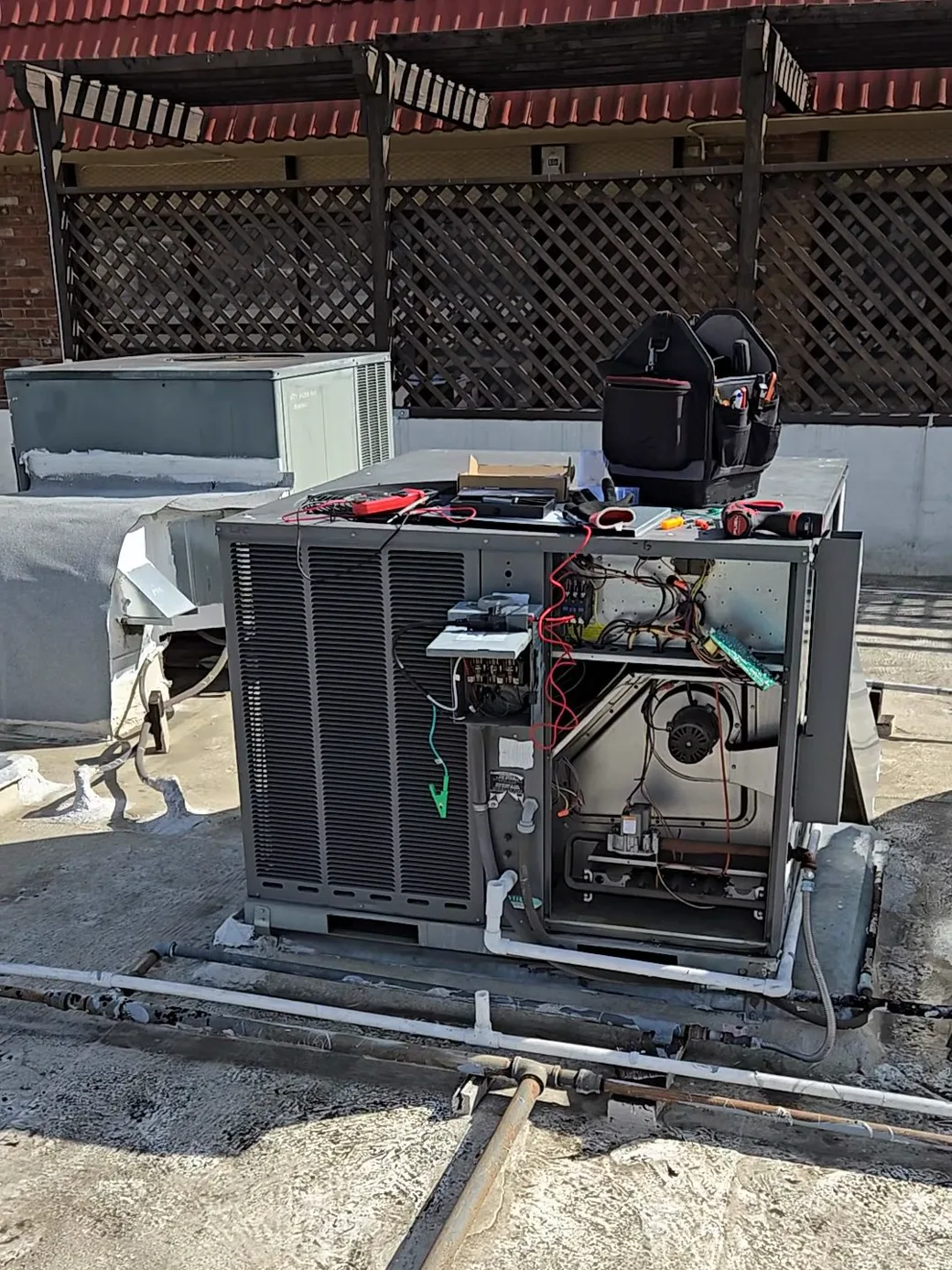
The call came from a pharmacy: no heat, customers in coats, staff eyeing the thermostat. The heat for the building comes from a packaged unit on the roof — a gas pack, the all-in-one cabinet you see on top of nearly every storefront in Los Angeles. The unit had shut its burners down and was flashing a fault: high limit switch open. (The short clip from this exact job is at the top of the page.)
That error code is where a lot of repairs go wrong. Here’s what it actually took to fix this one — and why the obvious $400 answer would have been the wrong one.
The easy answer: condemn the board
When a rooftop unit reports a safety fault that won’t clear, there’s a well-worn script: blame the control board. Swap it, invoice it, done. And to be fair, the board was the problem here — just not in the way that script assumes.
An original control board for this unit runs about $300–400 for the part alone, plus labor, plus however many days the business sits without heat waiting for it to arrive. For a pharmacy, that’s days of cold customers and cold staff. So before anyone orders anything, the accusation deserves a proper trial: is the high limit switch actually open?
Testing what the board was accusing
A high limit switch is a simple safety: if the unit overheats, the switch opens, the circuit breaks, and the burners shut down. The board was claiming that circuit was open. This unit has three switches on that loop — two on the burners, one on the blower — and every one of them tested closed. The safety devices were fine.
Next suspect: the wiring between the switches and the board. We rang it out end to end. Continuity everywhere. Also fine.
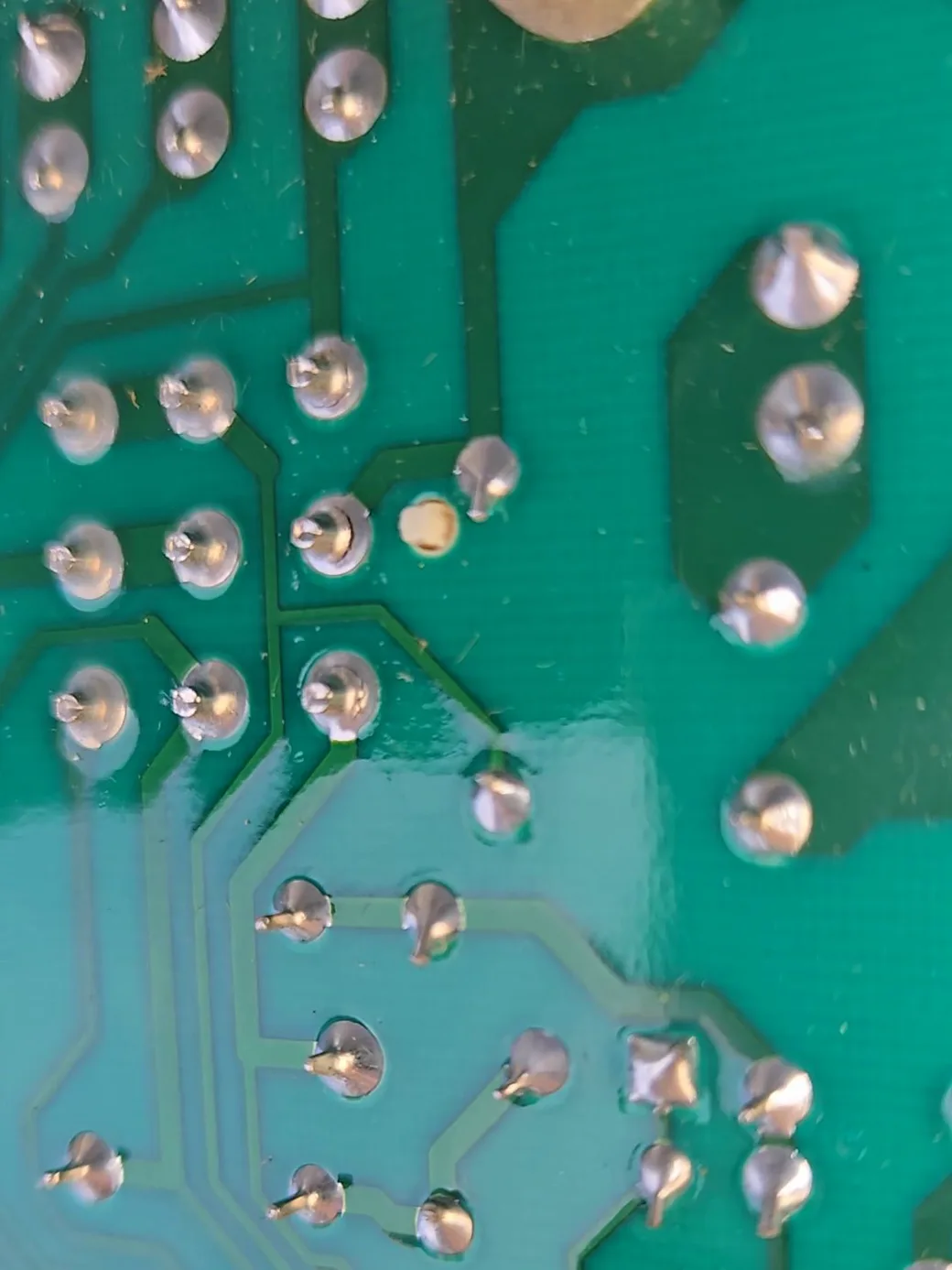
So the switches were closed, the wires were good, and the board still insisted the circuit was open. At that point the board isn’t a witness anymore — it’s the suspect. We pulled it and flipped it over.
Ring cracks: the failure you can’t see from the front
On the solder side of the board, around the pins of the connector that receives the safety circuit, were hairline fractures — ring cracks, circling the contacts. They’re called cold solder joints once they’ve let go: the joint looks attached, but electrically it’s a coin toss.
This is one of the most common ways electronics die, and not just in HVAC. Solder is soft metal. Vibration flexes it; every heating and cooling cycle expands and contracts it. A rooftop unit delivers both, all day, for years — the blower shakes the cabinet while the electronics swing from cold night air to burner heat. Eventually the solder fatigues and a crack forms a ring around the pin. The connection goes intermittent, then open. The board, reading its own broken joint, reports a fault in a circuit that’s perfectly healthy.
The cruel part: from the component side, the board looks immaculate. Nothing burned, nothing swollen. Unless a tech flips it over and inspects the solder side, the diagnosis defaults to “bad board, replace it” — and the new $400 board fixes the problem only because it happens to come with fresh solder.
The fix: a soldering iron on the roof
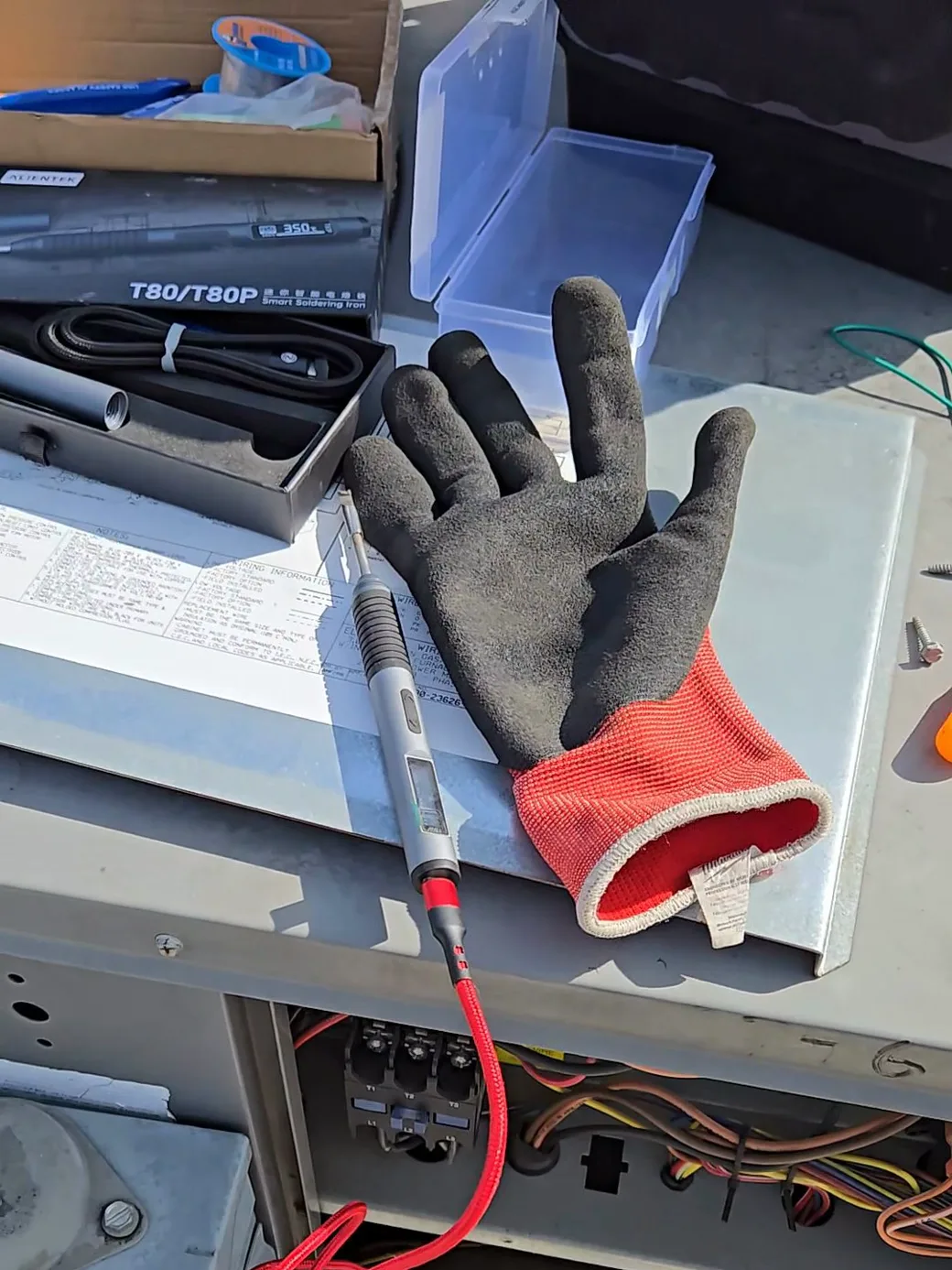
The repair for cracked joints is called a reflow: heat each suspect joint and let fresh solder fuse the crack back into one solid connection. It’s precise work, but it’s not expensive work.
The only real obstacle was the location: there’s no wall outlet on a roof.
Joints reflowed, board remounted, connectors seated. The board read all three switches closed — because they always were — the burners lit, and the pharmacy had heat again the same visit. No part ordered, no days of downtime, no $300–400 board.
Repair vs replacement: the honest math
We’re not against replacing control boards — sometimes it’s the only correct call. Burned traces, a cooked relay bank, water intrusion, a dead microcontroller: that’s replacement territory, and we’ll say so. (We wrote about how we make that call across appliances in our repair-or-replace guide.)
But cracked solder is not a dead board. It’s a $400 part with a $0.02 problem. The math on this job:
- Board replacement: $300–400 part + labor + days waiting on shipping, business cold the whole time.
- Board repair: one visit, a fraction of the cost, heat back the same visit — with a 30-day labor / 90-day parts warranty behind it.
A reflowed joint is fresh solder — arguably in better shape than the forty other factory joints around it that have been fatiguing just as long.
What this means when your unit throws a code
An error code is the board’s opinion. It’s where diagnosis starts, not where it ends. If a tech reads the code, declares the board dead in ten minutes, and quotes you a replacement without testing a single switch or wire — that’s not a diagnosis, that’s a script. Get a second opinion before you approve it.
We test the circuit, we flip the board, and we tell you what we actually find — with photos, on your roof if that’s where the problem lives. Ask about available appointments; timing depends on scheduling and parts.
Registered CA BEAR #A 50636 · EPA Section 608 Universal certified · $1M insured · 1,266+ repairs completed. Serving the Westside and San Fernando Valley: West Hollywood, Beverly Hills, Santa Monica, Culver City, Sherman Oaks, Studio City and nearby. Storefronts, offices, and property managers welcome — and if your cooling side needs attention too, we do AC tune-ups while we’re up there.
Call or text (213) 205-2055 — flat rate quoted upfront, $85 service call credited toward the repair.
FAQ
What does 'high limit switch open' mean on a furnace or packaged unit?
The high limit switch is a safety device that opens the circuit if the unit overheats, which shuts the burners down. When the control board reports that fault, it means the board sees an open circuit on that safety loop. It does not automatically mean the switch tripped — the switch, the wiring, or the board's own connections can all produce the same reading. That's why each one has to be tested before anything gets replaced.
What are ring cracks or cold solder joints?
They're hairline fractures in the solder that connects a component or connector pin to the circuit board. Years of vibration and heating-and-cooling cycles fatigue the solder until a crack forms a ring around the pin. The connection turns intermittent, then opens completely — and the board starts reporting faults in circuits that are perfectly healthy. It's one of the most common failure modes in appliance and HVAC electronics, and it's invisible unless you flip the board and inspect the solder side.
Can an HVAC control board be repaired instead of replaced?
Often, yes. Cracked solder joints, tired connector pins, and a failed relay are all board-level repairs — reflowing the joints or replacing the single failed component costs a fraction of a new board. Replacement is the right call when the damage is structural: burned traces, a cooked transformer section, water damage, or a microcontroller fault. A tech who actually inspects the board can tell you which case you're in.
How much does an HVAC control board replacement cost?
For the packaged unit in this story, the original manufacturer's board was around $300–400 — before labor, and before the days of downtime while the part ships. A board-level repair like reflowing cracked solder joints costs far less and gets done in the same visit. We quote a flat rate upfront either way, and the $85 service call is credited toward the job.
Why do control boards fail in rooftop units?
Rooftop packaged units live a hard life: the blower and compressor shake the cabinet constantly, and the electronics swing from cold mornings to hot afternoons to burner heat, day after day. That combination — vibration plus thermal cycling — is exactly what fatigues solder joints and cracks them. Boards in rooftop units see more of it than almost any other appliance electronics.
The error code says one part failed. Should I just replace that part?
Not on the code alone. An error code tells you what the board thinks it sees, not what actually failed. In this job the board blamed the high limit switch, and all three switches on the unit tested fine — the board's own cracked solder was inventing the fault. Replacing parts by code without testing is how a $150 visit turns into a $700 pile of parts that didn't fix anything.
Does Epic Star work on commercial rooftop units in Los Angeles?
Yes — light commercial HVAC is part of what we do: packaged units (gas packs), rooftop units, and the storefronts and offices under them, across the Westside and San Fernando Valley. We handle the electrical and control-board level diagnostics that many light-commercial techs won't touch. Call or text (213) 205-2055.
Is a repaired board covered by a warranty?
Yes. Our work carries a 30-day labor and 90-day parts warranty, the same as any other repair we do. A properly reflowed joint is typically stronger than the factory original, because it's fresh solder without fifteen years of fatigue.
AC, heater or mini-split acting up? We cover LA and the Valley.
Call (213) 205-2055 or text a photo of the unit and its model sticker.