
Every Quote Started With 'Well, It's a Commercial Unit…' — What a Rooftop Blower Motor Replacement Actually Involves
A nail salon with no AC, a burned-out 1.5 HP blower motor, a pulley that refused to fit the new shaft, and the difference between a fair commercial price and a padded one.
In this guide
The owner of a nail salon called us on a warm week with a simple problem and a complicated feeling. The problem: her AC was dead — the rooftop package unit had stopped pushing air, and a salon full of clients, lamps, and acetone fumes gets unbearable fast without it. The complicated feeling: she’d already collected several quotes, and every one of them was high enough to make her wince. Each came with the same explanation, delivered with a sigh: “Well, it’s a commercial unit.” (The short clip from this job is at the top of the page.)
Here’s the thing — that sentence is half true. And the half that isn’t true is where a lot of small businesses in Los Angeles quietly overpay.
What “it’s commercial” legitimately means
The other companies aren’t inventing the premium from nothing, so let’s start with the part that’s real.
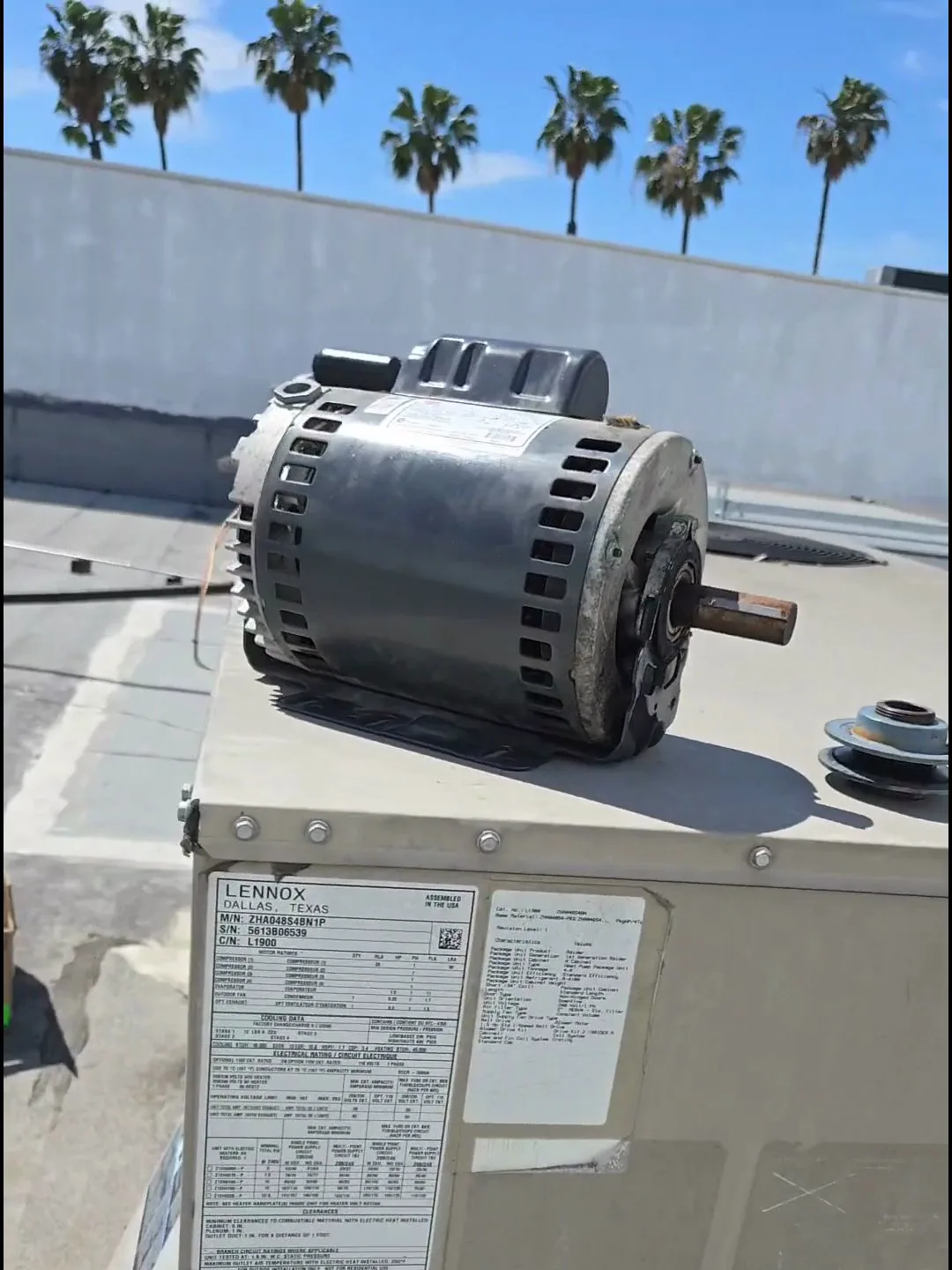
A rooftop package unit (an RTU — the big box on the roof that holds the whole system in one cabinet) really is built differently from the equipment in a house. The blower in this one wasn’t a little direct-drive furnace fan; it was a belt-drive assembly run by a 1.5-horsepower NEMA-frame industrial motor. A motor like that costs several times what a residential blower motor does, and it’s not stocked at the hardware store. The belt-drive design adds parts a homeowner never buys — a drive sheave, a belt, adjustable mounts. And the work happens on a roof: ladder or hatch access, parts carried up, everything done in the sun.
So yes: commercial parts cost more, and commercial labor takes longer. A fair commercial quote is higher than a residential one.
But “higher” and “triple” are different words. On a job like this one, the honest math is a motor, a sheave, a belt, and a day of skilled labor. When a quote lands far above that, the word “commercial” isn’t describing the parts anymore — it’s describing the customer.
The diagnosis: cooked windings, no mystery
The diagnosis on this unit took minutes, which is exactly how a blower motor failure usually goes. The motor had burned out — windings cooked, the smell still on it. When the blower dies, the effect on the business is total even though most of the system is fine: the compressor can make all the cold it wants, but with no fan, none of it reaches the rooms. Airflow is the delivery truck. No truck, no delivery.
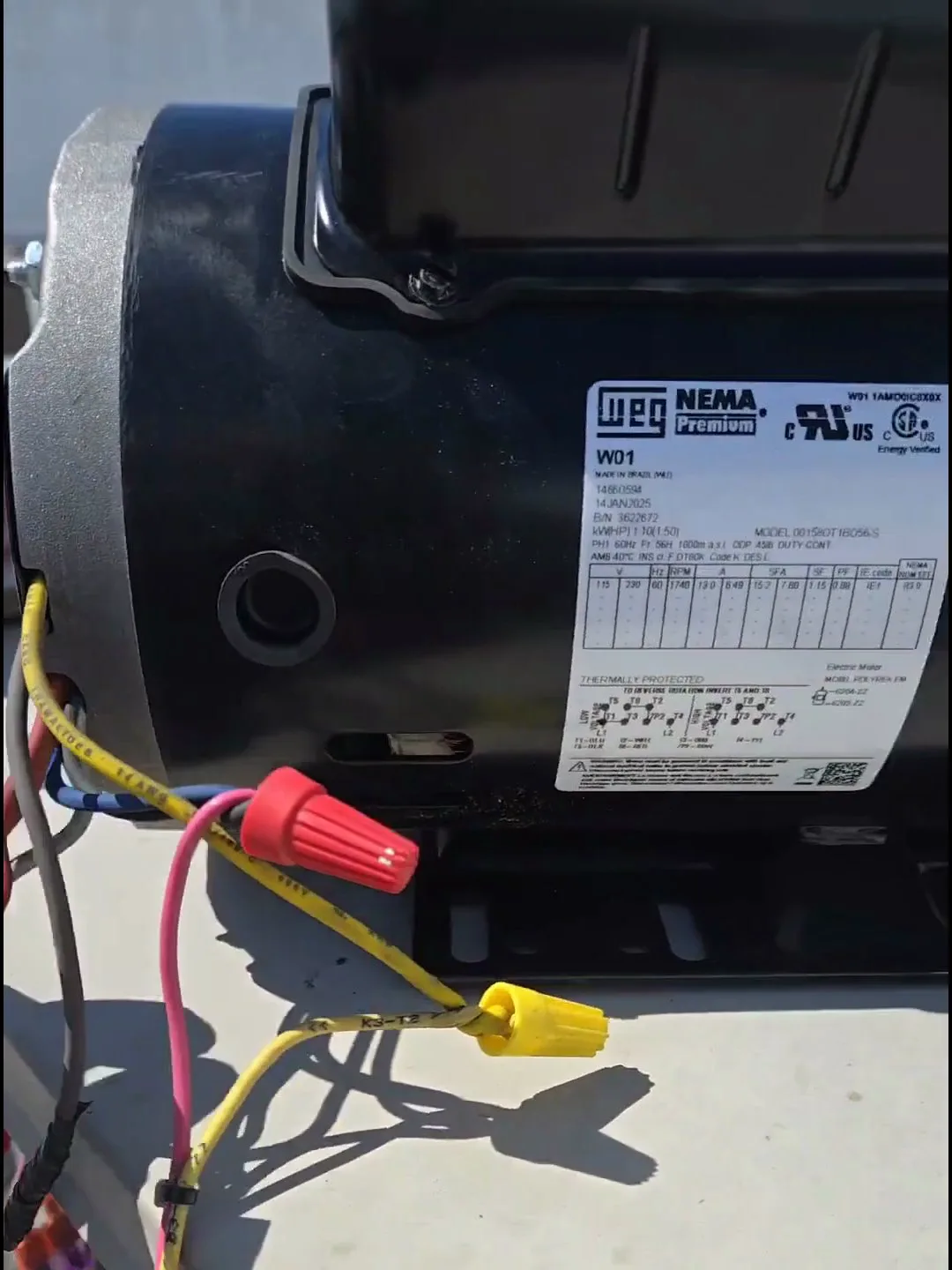
We sourced a matching replacement — a WEG NEMA Premium, about 1.5 HP — and this is where the job stopped being routine, in a way worth knowing about if you ever hire this work out.
The snag: a 7/8” pulley on a 5/8” shaft
First, a nuance we checked before anything else: rotation direction. On motors like this, which way the shaft spins is not set by how you land the power wires. The connection diagram differs for 115-volt and 230-volt hookups, and direction is reversed on its own dedicated terminals, per the diagram. A tech who assumes “swap two power leads to reverse it” — true on plenty of other motors — can leave a commercial blower running backwards, moving a fraction of its rated air while looking perfectly healthy. We spun the new motor up on the bench first: correct rotation, good.
Then the real snag. The old motor’s shaft measured 7/8 of an inch. The new motor’s shaft: 5/8. The old drive sheave — the pulley that the belt rides on — has a fixed bore, and it physically would not mount on the new shaft. No amount of wishing changes a quarter of an inch.
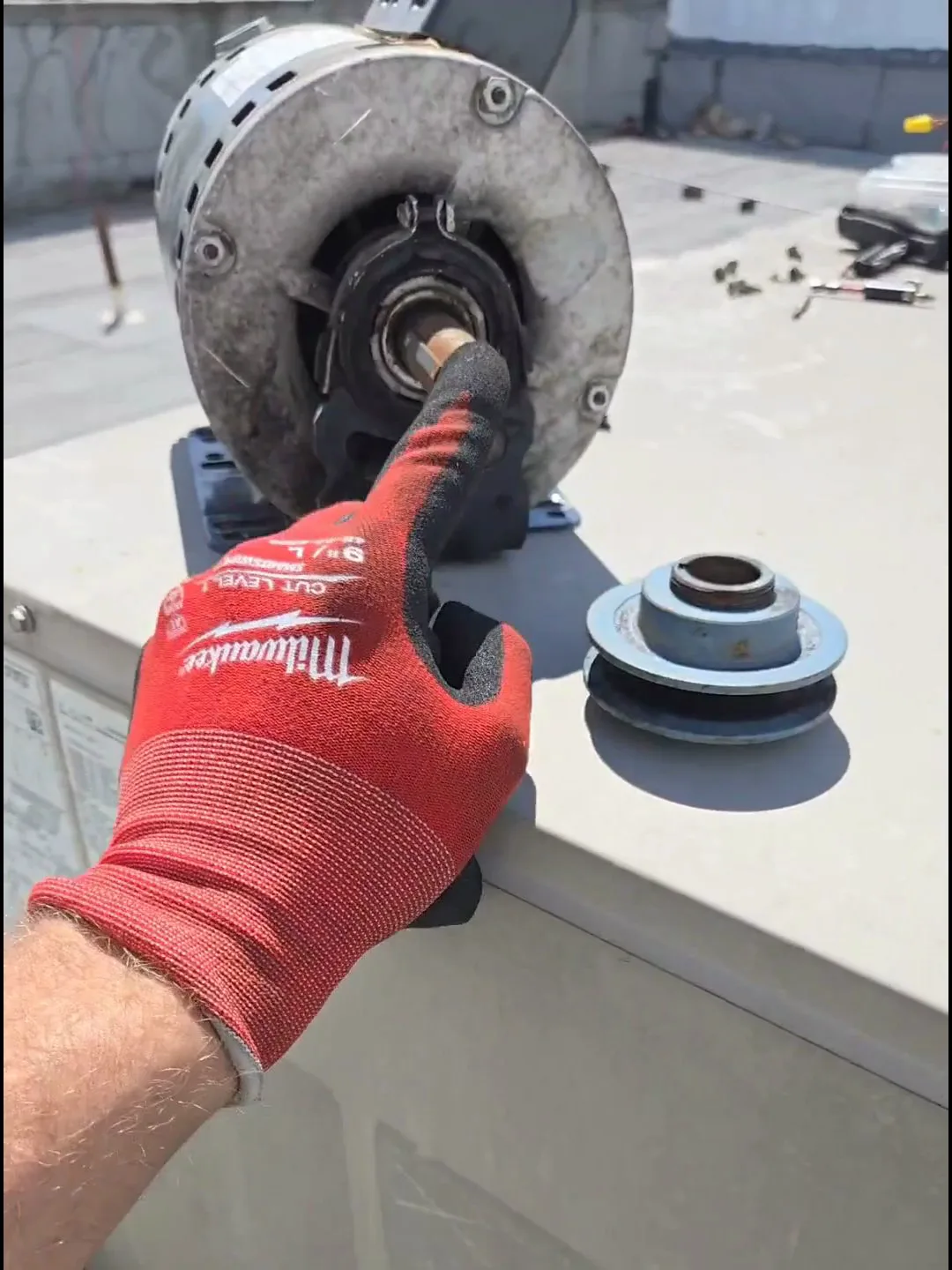
This is a completely ordinary problem in commercial motor swaps, and it’s also where repairs go sideways. The wrong answers are: force something with a sleeve that wasn’t engineered for it, or leave the unit dead for a week waiting on an exact-shaft motor. The right answer is boring — a trip to the supply house for a sheave with the correct 5/8” bore that keeps the same drive ratio, so the blower turns at the speed the unit was designed for. While we were at it, a fresh belt. Putting a stretched, glazed old belt on a brand-new drive is how you buy a second service call for the price of saving fifteen dollars.
Pulley set, belt tensioned, spinning true.
Why we didn’t stop at the motor
Here’s the part that separates a repair from a parts swap, and it’s also where “cheaper than the other quotes” and “better than the other quotes” turn out to be the same move.
Blower motors rarely burn out for no reason. Heat kills them, and the two biggest sources of extra heat are a matted evaporator coil and clogged filters — both of which force the motor to strain against restricted airflow, all day, every day. A nail salon is a hard environment for filters: lots of air movement, dust, and product in the air. If we had bolted in a beautiful new motor and left the coil and filters as they were, the new motor would have inherited the exact workload that cooked the old one.
So while the unit was open: evaporator coil cleaned, fresh air filters in. Then, with gauges already on the system, we checked the refrigerant charge and found it a touch low — typical for a unit this age — and brought it up to spec. An undercharged unit still cools; it just runs longer and works harder to do it, and the owner pays for that inefficiency on every electric bill. Topping it off cost little while we were there and means the salon got its unit back at full capacity, not limping.
Buttoned up, tested, cooling. The salon was back in business the same day — at a price meaningfully under the bids that started with a sigh.
What a fair commercial quote looks like
If you run a salon, a shop, a restaurant, or an office and your rooftop unit dies, here’s the short version of what this job taught:
- Ask for parts and labor separately. A fair quote survives itemizing. A padded one gets vague.
- Expect the drive side as a set. Motor, sheave, belt. If the quote is motor-only on a belt-drive unit, ask what happens when the old sheave doesn’t fit the new shaft — because often it doesn’t.
- A motor replacement should come with the “why did it die” question answered. Coil condition, filter condition, airflow. Otherwise you’re buying the same failure twice.
- “Commercial” justifies a premium on parts and roof labor. It does not justify a mystery multiplier on the whole number.
We quote flat-rate, upfront, before the work starts, and the $85 diagnostic is credited toward the repair. If your building’s AC is down and every number you’ve heard so far came with the word “commercial” doing suspiciously heavy lifting — call or text Epic Star at (213) 205-2055. We’ll tell you what it actually takes.
FAQ
Why is commercial HVAC repair so much more expensive than residential?
Some of it is legitimate. Commercial rooftop units use bigger, industrial-grade parts — a 1.5 HP NEMA-frame blower motor costs several times what a residential furnace motor does, and belt-drive systems add a sheave and belt to the bill. The work happens on a roof, which means more setup time and sometimes lift equipment. But a chunk of many commercial quotes is simply the word 'commercial' doing the pricing. The honest way to tell the difference: ask for the quote broken into parts and labor. A fair price holds up when you ask; an inflated one usually can't explain itself.
What does the blower motor actually do in a rooftop package unit?
It's the motor that moves air — the compressor makes the cold, but the blower pushes that cold air through the ductwork and into the building. When it burns out, the compressor side may still technically run, but nothing arrives at the vents. That's why a dead blower feels like the whole system died at once: airflow is the delivery truck for everything the unit produces.
How do I know my blower motor is failing before it dies completely?
The classics: a humming unit with no air at the vents, breakers tripping when the fan tries to start, a burning-electrical smell from the returns, or airflow that's gotten noticeably weaker over weeks. Belt-drive units add their own warning — a squeal at startup usually means the belt is glazed or loose, and a belt that keeps loosening can point at bearings on their way out. Any of those is worth a service call while it's still a small repair.
Why did the pulley need to be replaced along with the motor?
Because the new motor's shaft was a different diameter than the old one — 5/8 inch against 7/8. The drive sheave (the pulley on the motor shaft) has a fixed bore, so the old sheave physically couldn't mount on the new motor. This happens a lot in commercial motor swaps: an exact-shaft replacement isn't always available or worth waiting a week for, so the right move is a matched sheave with the correct bore that keeps the same drive ratio. It's a cheap part — but if the tech doesn't check shaft diameter before ordering, your one-day repair becomes a three-day one.
Should the belt be replaced whenever the blower motor is replaced?
Yes — and it's arithmetic more than salesmanship. The belt costs a fraction of the service call it would take to come back and replace it separately in six months. An old belt has stretched and worn into the shape of the old drive setup; putting it on a fresh motor and sheave means a new repair driven by the cheapest part in the system. New motor, new sheave, new belt — the drive side is done as a set.
Why clean the evaporator coil and change filters during a motor replacement?
Because a dirty coil and clogged filters are exactly what makes blower motors work harder and run hotter — sometimes they're a big part of why the old motor cooked in the first place. A salon moves a lot of air with product smells and dust in it, and filters load up faster than in an office. Replacing the motor while leaving a matted coil and choked filters in place means the new motor inherits the same strain that killed the old one. Coil cleaned, filters fresh, the motor breathes — that's how the replacement lasts.
Why top off the refrigerant when the problem was the motor?
We checked the charge after the airflow was fixed, and it was a bit low — common on a unit this age. Running slightly undercharged doesn't stop a unit from cooling, but it makes it work longer and harder for the same result, which costs the owner money every month on the electric bill. Since we were already there with gauges on it, bringing the charge to spec meant the salon got the unit back at full efficiency, not just back to 'running.' One caveat: a big refrigerant loss is a leak, and a leak needs finding — not topping off every season.
Does Epic Star handle commercial HVAC in Los Angeles?
Yes — rooftop package units, split systems, and mini splits for salons, shops, restaurants, offices, and other small commercial spaces across the Westside and San Fernando Valley. Flat-rate pricing is quoted upfront, and an $85 diagnostic is credited toward the repair. Ask about available appointments; timing depends on scheduling and parts.
Got an appliance that needs fixing? We cover LA and the Valley.
Call (213) 205-2055 or text a photo of your appliance.