
A 20-Year-Old Sub-Zero Stopped Cooling. Here's the Repair Most Techs Won't Touch
Two refrigerant leaks, one hand-bent copper loop — and a built-in classic saved from the landfill.
In this guide
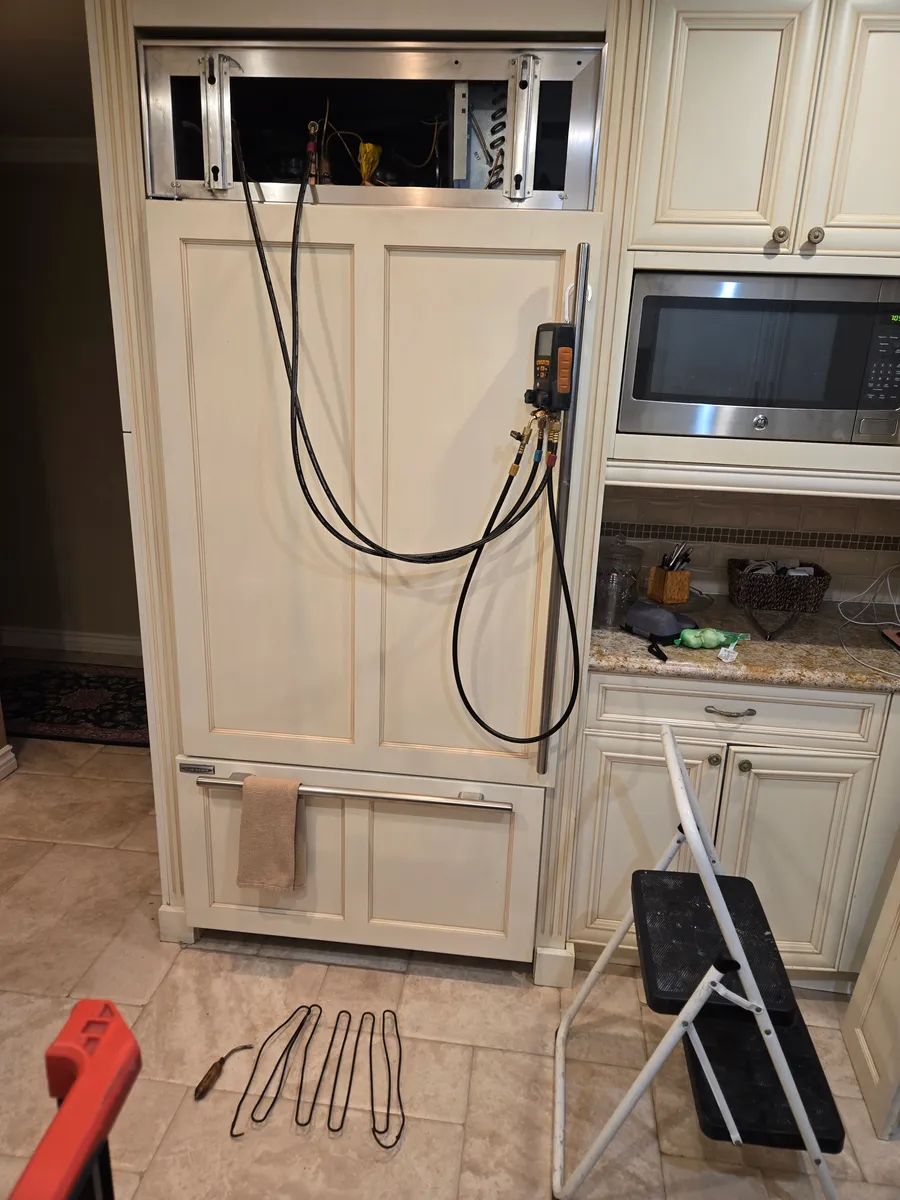
This built-in, panel-ready Sub-Zero has been running in a Los Angeles kitchen for about twenty years. Both of its sealed systems were still factory-sealed — in two decades, nobody had ever opened them. Then one day it simply stopped cooling. The verdict most owners hear at that point is brutal: “it’s old, replace it.” The video at the top of this page shows why that verdict is often wrong.
Refrigerant doesn’t wear out — it escapes
A refrigerator doesn’t “use up” refrigerant the way a car uses gas. The refrigerant moves in a closed, sealed loop, so if the system is empty, there is exactly one explanation: a leak. When we put gauges on this Sub-Zero, the sealed system had lost essentially all of its charge. Topping it off and walking away would have bought the owner a few weeks at best — the same false economy we see with AC condensers “low on freon”. The real job is to find the leak, fix it, and prove the system holds before recharging.
Finding a leak the right way
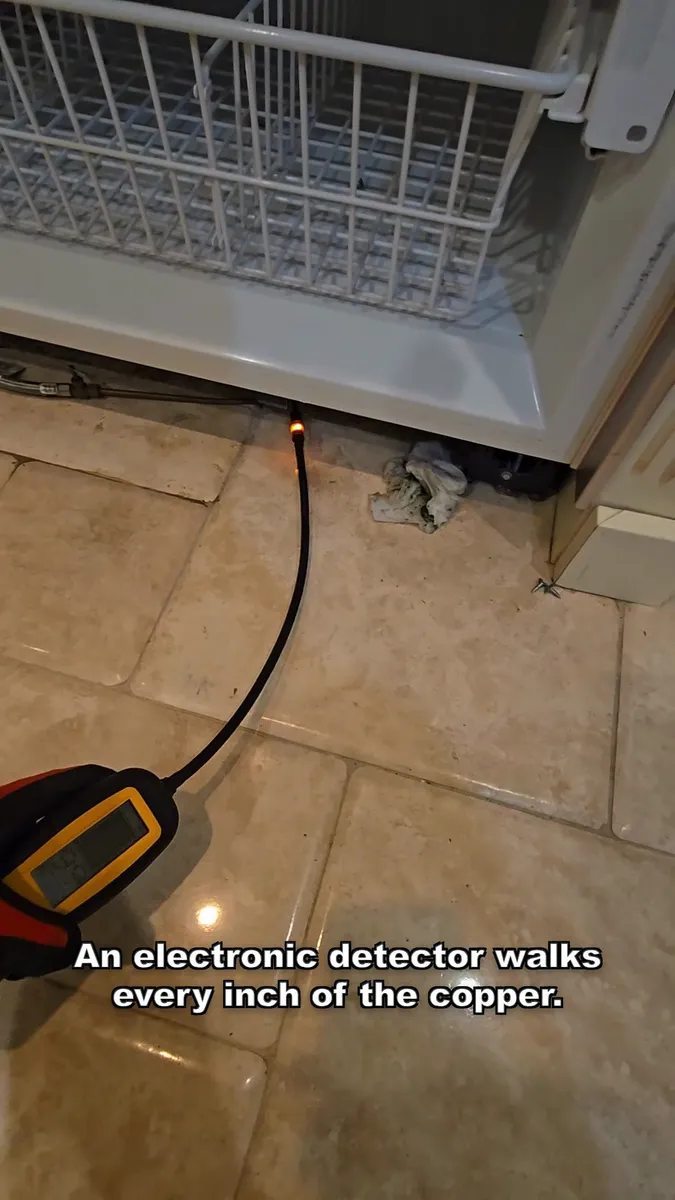
We connected a Testo digital manifold, pressurized the system with nitrogen, and walked every inch of the copper with an electronic refrigerant leak detector. On a built-in unit this takes patience — the lines run under, behind and inside the cabinet. The detector didn’t take long to sound off the first time.
Leak #1: the loop that spends its life sitting in water
The first leak was under the fridge, in the condensate loop — a run of tubing that carries hot refrigerant through the drain pan to boil off the water left over from every defrost cycle. It’s a clever piece of engineering with one built-in weakness: that copper sits in water its entire life. It is almost always the first part of the system to corrode. After twenty years, this one hadn’t just pinholed — it had rotted through in several places.
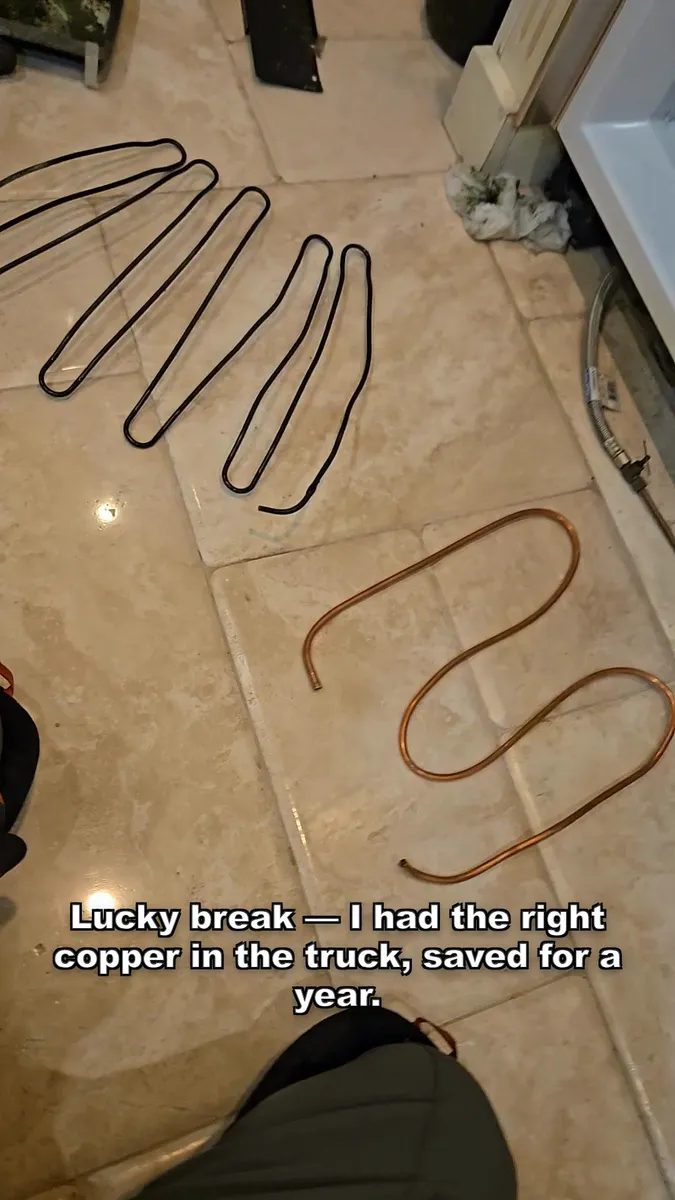
A loop that far gone isn’t worth patching hole by hole. We cut the entire run out and replaced it. Here’s the part that saved the day: the right diameter of copper tubing had been riding in our truck for a year, waiting for exactly this job. The new loop was bent by hand to match the original’s shape and brazed into the circuit.
Leak #2: the loop you can’t replace — and what to do instead
With the condensate loop fixed, the detector found a second, quieter leak: the door anti-sweat heater loop, a line that routes warm refrigerant around the door opening so the cabinet doesn’t sweat in humid weather. Unlike the condensate loop, this one runs inside the cabinet structure — it physically cannot be replaced. The correct fix is to cut it out of the circuit entirely. The refrigeration system runs perfectly without it; the only theoretical trade-off is minor condensation around the door frame on the most humid days — a non-issue in the LA climate, and far better than a refrigerator that doesn’t run at all.
Filter-dryer, deep vacuum, weighed charge
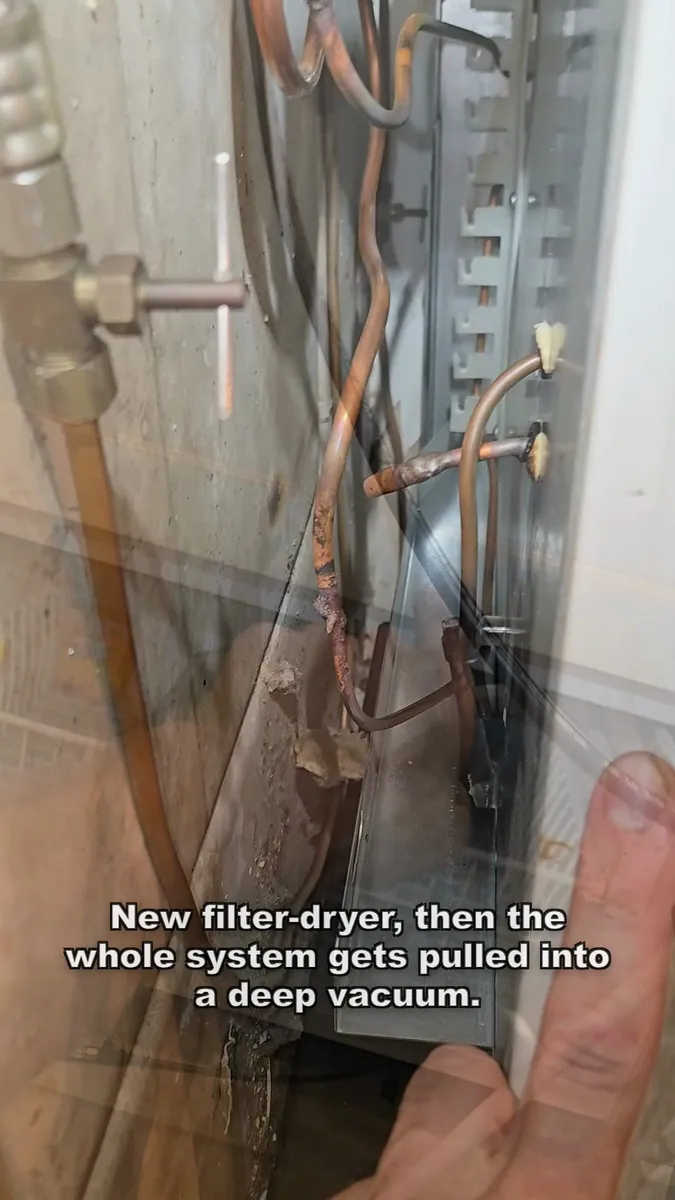
Any time a sealed system is opened, the filter-dryer must be replaced — it’s the component that traps moisture and debris, and a saturated one will slowly kill a compressor. New filter-dryer in, we pulled the system down into a deep vacuum and let it prove it could hold. Only then does refrigerant go back in — weighed in to specification, not “topped off by feel.”
Repair or replace a 20-year-old Sub-Zero?
Run the numbers. A new built-in Sub-Zero typically costs $9,000–$15,000+ before you touch the cabinetry it’s paneled into. A sealed-system leak repair — diagnosis, copper work, filter-dryer, evacuation and recharge — is a small fraction of that. And unlike most modern refrigerators, these units were built to be serviced: heavy compressors, real copper, twenty years on factory-sealed circuits. Repaired, this one held a deep vacuum and took its charge by weight. That math is why we treat “just replace it” as the last resort, not the first — the same philosophy behind our refrigerator repair work on Sub-Zero and other premium brands.
What Sub-Zero owners should watch for
Because built-in Sub-Zeros use two independent sealed systems, trouble usually shows up on one side first: the refrigerator section warming up while the freezer holds (or the reverse), a compressor that runs non-stop, or food spoiling faster than it should. If any of that sounds familiar, don’t let anyone condemn the unit — or “top it off” — without a proper electronic leak search first.
Sub-Zero not cooling in Los Angeles? We perform sealed-system work for these units. Ask about available appointments; timing depends on scheduling and parts. Our work carries 30-day labor and 90-day parts warranties. Call or text (213) 205-2055, or book online.
FAQ
Why did my Sub-Zero stop cooling?
In a sealed refrigeration system the refrigerant never "runs out" — if the charge is gone, there's a leak. On older built-in Sub-Zeros the most common culprit is the condensate loop under the unit, which sits in defrost water and corrodes before anything else.
Is a 20-year-old Sub-Zero worth repairing?
Usually yes. A new built-in Sub-Zero runs $9,000–$15,000+ plus cabinetry work, while a sealed-system repair is a small fraction of that — and these units are built to be serviced, often running 30+ years with proper care.
Can't you just add more refrigerant?
A top-off without fixing the leak lasts weeks at best, wastes refrigerant, and can mask damage until the compressor fails. The correct repair is: find the leak electronically, fix or bypass it, replace the filter-dryer, pull a deep vacuum, then recharge to spec.
What is the condensate loop and why does it leak?
It's tubing that routes hot refrigerant through the drain pan to evaporate defrost water. Because it sits in water constantly, it's typically the first part of the system to rot through — often in multiple spots at once, which is why we replace the whole loop rather than patch it.
What if the leak is in a part that can't be replaced?
Some lines, like the door anti-sweat heater loop, run inside the cabinet structure. Those are safely cut out of the circuit — the refrigeration system runs fine without them, with no meaningful downside in a dry climate like LA.
Why does the filter-dryer need replacing?
Any time a sealed system is opened, moisture and debris can enter. The filter-dryer traps both; reusing an old one risks acid formation and premature compressor failure, so replacing it is standard practice on every sealed-system repair.
Got an appliance that needs fixing? We cover LA and the Valley.
Call (213) 205-2055 or text a photo of your appliance.