
LG Refrigerator Not Cooling? Inside a Real Compressor Replacement in Santa Monica
A previous company condemned the compressor and vanished. Here's how we confirmed it, replaced it, and saved the homeowner from buying a fridge he didn't want.
In this guide
When an LG refrigerator stops cooling, most people fear the worst: a dead fridge headed for the curb. Usually the problem is a single part — the compressor — and replacing it costs a fraction of a new built-in-fit refrigerator. This LG LFX25991ST in Santa Monica is a good example. It had quit cooling completely, another company had already condemned the compressor and then gone quiet, and the homeowner was days from buying a replacement he didn’t actually want. (There’s a short clip from this exact job at the top of the page.) Here’s what we found, how we confirmed it, and why a $1,300 repair made more sense than a new fridge.
A compressor that runs but doesn’t cool
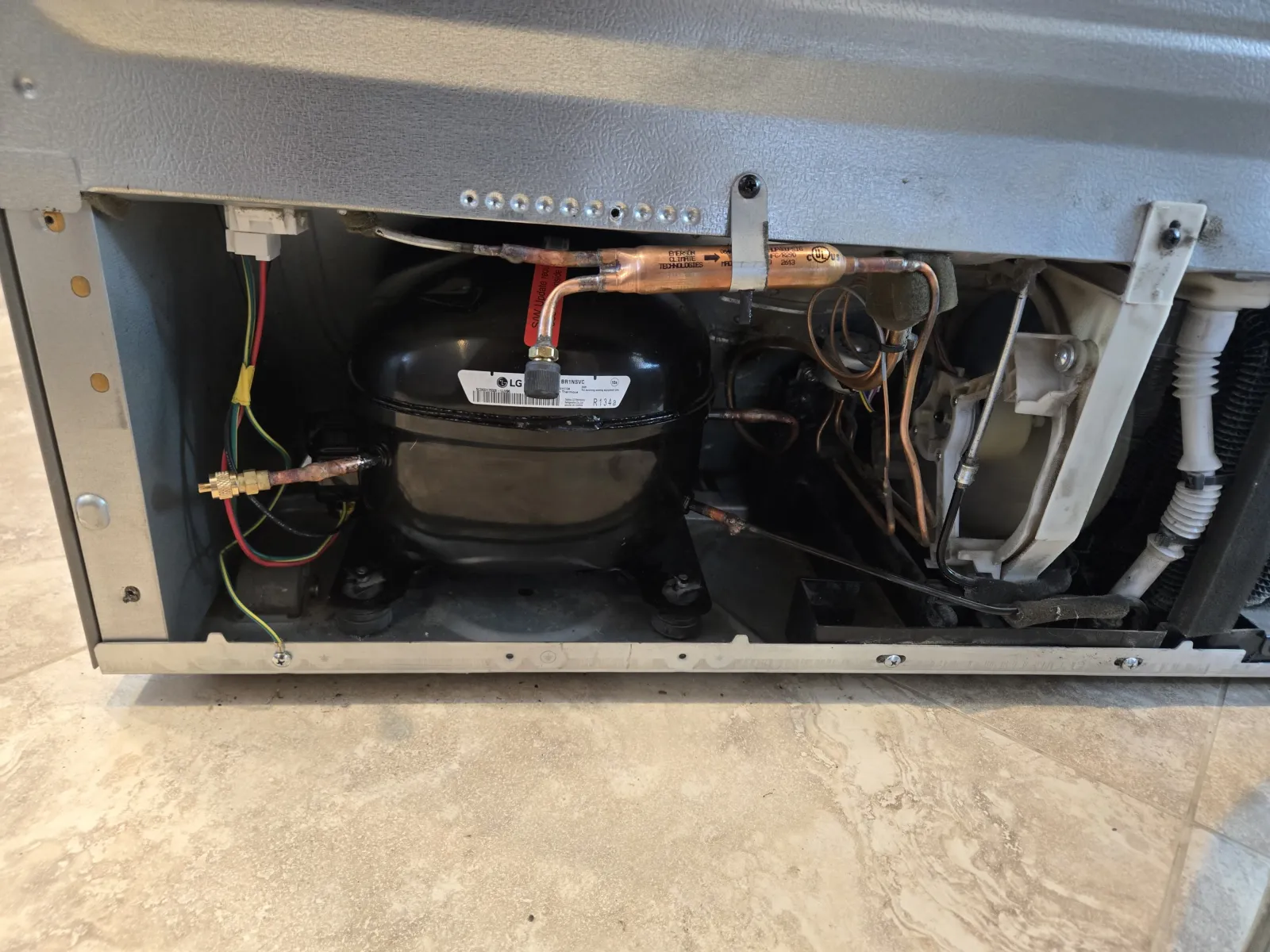
The confusing thing about a failed compressor is that it often still turns on. You can hear it hum. The fridge sounds alive. But sound isn’t cooling. The compressor’s job is to pump refrigerant through the sealed system, and it can run electrically while doing almost no pumping at all. That was exactly the situation here — the LFX25991ST powered up, the compressor energized, and the box stayed warm because no refrigerant was moving.
That gap between “running” and “working” is why a fridge that won’t cool gets misdiagnosed so often. We wrote a fuller breakdown of the usual suspects in why a refrigerator stops cooling, but on this unit the symptom pointed hard at the compressor from the start.
”Condemned” by one company, then silence
Before we arrived, another company had already been out. They told the homeowner the compressor was bad — and then went quiet. No quote to finish the work, no follow-up, no return call. He was left holding a diagnosis with nobody willing to stand behind it.
We don’t take that kind of call at face value. A previous “it’s the compressor” is a starting point, not a verdict. Compressors get blamed all the time for problems that turn out to be a start relay, a control board, or a slow refrigerant leak — none of which need a $1,300 repair. So before we quoted anything, we confirmed it ourselves.
How we confirmed the compressor was dead
To know whether a compressor is actually pumping, you have to read the system pressure. On a sealed unit with no service ports, that means tapping into the line. We installed a piercing valve — a saddle fitting that clamps onto the process tube and pierces it — so we could put a gauge on the system.
With the compressor running, it simply wasn’t building pressure. A healthy compressor creates a clear difference between the low and high sides within seconds of starting. This one didn’t move the needle the way a working compressor should. That’s a dead compressor confirmed on the gauge, not guessed from the symptoms. It matched what the first company had said — but now we knew it firsthand, and we were prepared to actually do the work.
Why this keeps happening to LG refrigerators
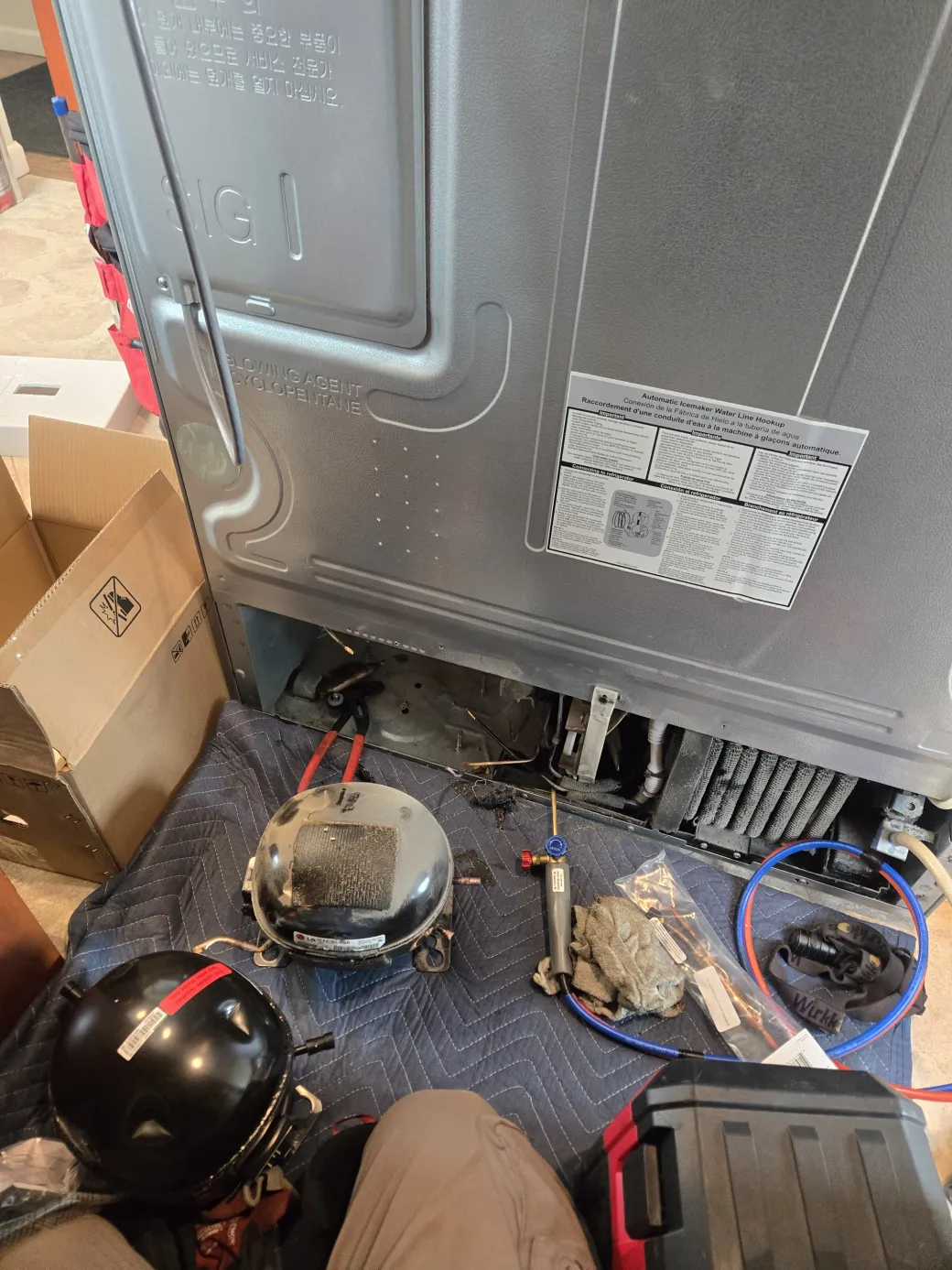
We see this constantly on LG. The LFX-series refrigerators of this era use an LG linear compressor — a design LG backed with a 10-year compressor warranty, and the same design that became the subject of a class-action settlement over French-door units that lost cooling without warning. That history tells you how common the failure is. It also means it’s worth a two-minute check before you pay anything: if your fridge is still inside LG’s compressor-warranty window, the part may be covered, so look up your purchase date and LG’s coverage first. Most of the units we see are past that window, though, which turns it into a simple question — repair or replace.
This particular system runs on R134a refrigerant, printed right on the compressor, and the replacement is a direct R134a unit. None of that is exotic. It’s a known failure on a known platform, which is part of why we can diagnose and turn these around quickly.
What replacing a sealed-system compressor actually involves
This is where a compressor job separates from a normal appliance repair, and why it is not a DIY project. Replacing a sealed-system compressor means:
- Recovering the old refrigerant into a recovery machine — venting it to the air is illegal.
- Cutting the dead compressor out of the sealed loop.
- Brazing in the new compressor along with a fresh filter-drier. We don’t reuse the original part number here — LG revised these compressors, so we fit the updated, more reliable version instead of the early design that kept failing.
- Pressure-testing the new joints with dry nitrogen to prove there are no leaks.
- Evacuating the system with a vacuum pump to pull out every trace of moisture and air.
- Recharging with the exact charge the system is rated for — on this LFX25991ST, that’s 135 grams of R134a, weighed in on a scale, not guessed.
- Reflashing the control board with LG’s own programming tool so it runs the new compressor. On LG this step is mandatory — the board has to be reprogrammed to drive the replacement, and a board that was never reflashed will fight the new compressor. Most handymen skip it because they don’t own the tool. We don’t.
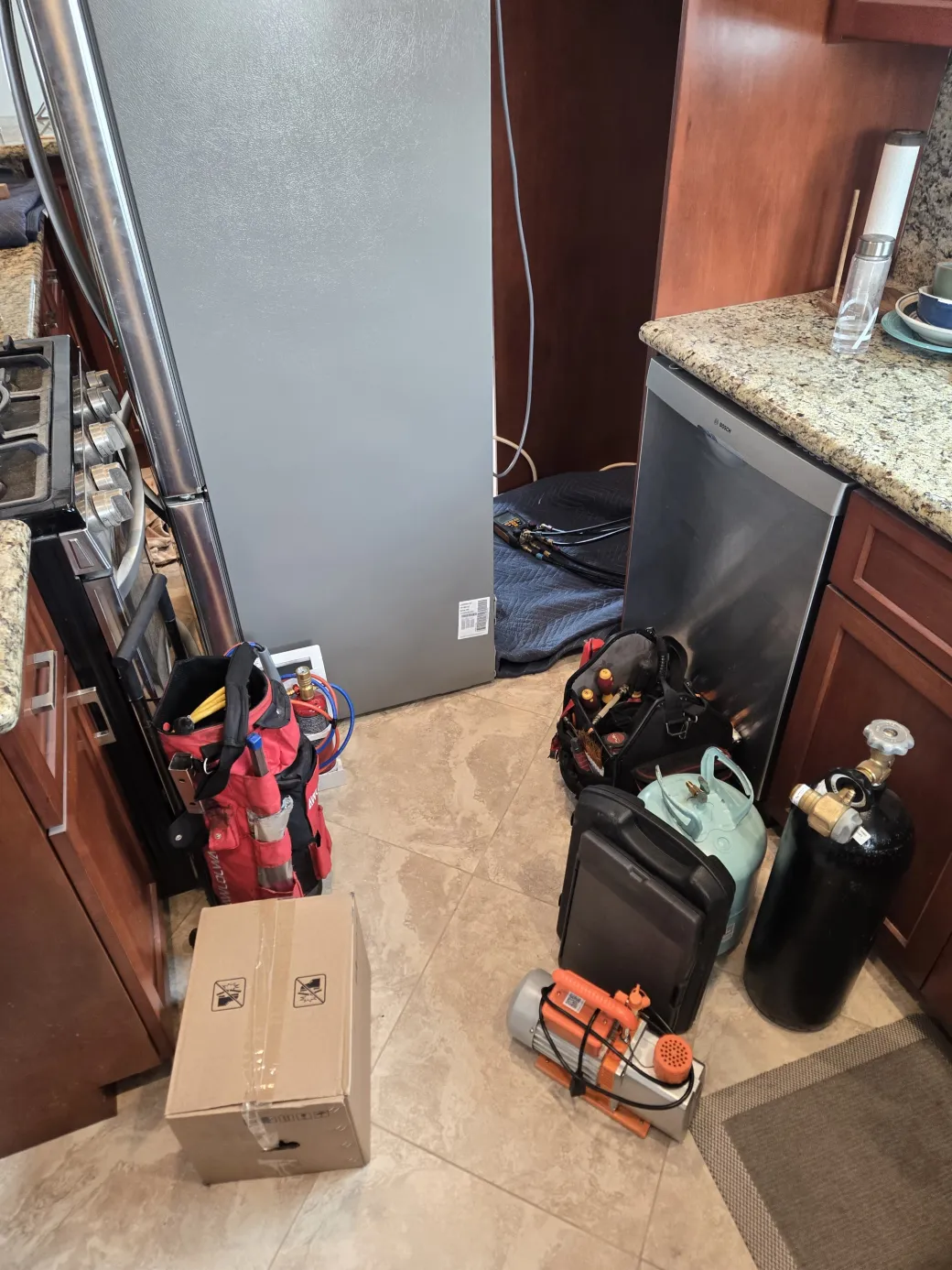
Every one of those steps needs EPA Section 608 certification, a brazing torch, recovery and evacuation gear, and — for the reflash — LG’s proprietary board programmer. It’s certified sealed-system work, not a part you swap with a screwdriver. Done right, the fridge cools like new. Done wrong — skip the vacuum, get the charge weight wrong, or never reflash the board — you trap moisture in the system or leave the board fighting the new compressor, and you’re back in a few months. That’s the difference between a repair that lasts and a repeat call. You can book that work through our refrigerator repair service, where the 16-second clip of this compressor swap plays.
Repair vs. replace: why $1,300 won
Most refrigerator repairs we do land between $180 and $650. A full sealed-system compressor replacement is the exception — the single most involved refrigerator repair there is — and this one came to $1,300. So why not just buy a new fridge?
Two reasons, both the homeowner’s:
| This repair | A new fridge | |
|---|---|---|
| Cost | $1,300 | $2,000–$3,000+ |
| Fit | Drops back into the existing niche | Different size; likely cabinet rework |
| The unit he wanted | Kept it | Started over |
The fridge sits in a cabinet niche built to its exact dimensions. A new counter-depth French-door wouldn’t slide into the same opening without a size change and cabinet work, on top of the purchase price. And he simply liked the fridge — it worked for his kitchen. Against a $2,000–$3,000+ replacement that also creates a remodeling problem, a $1,300 repair that returns the exact unit to working order is the easy call. If you’re weighing the same decision, our guides on when to replace a refrigerator and the broader repair-versus-replace math walk through it.
The water dispenser we fixed for free
While we had the unit apart, we sorted out a second complaint the homeowner had been living with: the water dispenser had stopped responding. Behind the dispenser pad, the micro-switches had corroded — a common failure in a spot that catches stray moisture — so pressing the paddle did nothing. We replaced the switch and got the dispenser working again at no extra charge.
It wasn’t the job we were called for. But it’s the kind of thing we’d want handled if it were our own kitchen, and it took a few minutes while we were already there.
If your LG is warming up on the Westside
A fridge that’s slowly losing temperature rarely recovers on its own. If your LG runs constantly but drifts warm, if the freezer holds while the fresh-food side doesn’t, or if you’ve already been told “it’s the compressor” by someone who never came back — get a second opinion before you replace the whole unit. We cover Santa Monica and the wider Westside, we confirm the diagnosis on a gauge before we quote, and we’ll tell you straight when a fridge isn’t worth saving.
Epic Star Inc has completed 1,266+ appliance repairs across Westside LA since 2024. We’re California BEAR registered (#A 50636), EPA Section 608 Universal certified, carry $1M general liability insurance, and back our labor with a 30-day warranty. Same-day appointments are subject to booking availability, and your $85 service call is credited toward the repair when service proceeds. We work in English and Spanish.
Call (213) 205-2055
FAQ
How much does it cost to replace an LG refrigerator compressor?
A full sealed-system compressor replacement on an LG refrigerator typically runs about $1,000 to $1,500, parts and labor included. The LG LFX25991ST in this story came to $1,300. It's the most involved refrigerator repair there is — most of our fridge repairs land between $180 and $650 — but it's still well under the $2,000-$3,000+ cost of a comparable built-in-fit French-door.
Why does my LG refrigerator run but not get cold?
Because the compressor can run electrically while doing almost no pumping. You hear it hum, so the fridge sounds alive, but no refrigerant is moving through the sealed system, so the box stays warm. The only way to know for sure is to put a gauge on the line and check whether the compressor is actually building pressure. On this LG, it wasn't.
Is it worth replacing the compressor on an LG refrigerator?
It depends on the fridge's age, condition, and how it fits your kitchen. For this homeowner it was an easy yes: the unit sits in a cabinet niche built to its exact size, a new fridge wouldn't drop into the same opening, and he liked the one he had. A $1,300 repair returned a fridge he wanted to keep, versus $2,000-$3,000+ plus cabinet work for a replacement.
Will a replacement LG compressor just fail again?
Not when it's done right. The early LG linear compressors on these models were the unreliable part — so we don't install another copy of the original. We fit LG's updated, revised compressor (a newer, more durable part number), reflash the control board with LG's own tool so it runs the new part, and pull a proper deep vacuum. The repeat failures we see almost always trace back to a skipped vacuum or a board that was never reprogrammed, not to the compressor itself.
Can I replace a refrigerator compressor myself?
No. Replacing a sealed-system compressor requires recovering the old refrigerant (venting it is illegal), brazing in the new compressor and a filter-drier, pressure-testing with nitrogen, pulling a deep vacuum, recharging with the exact weight of R134a, and — on an LG — reflashing the control board with LG's own programming tool so it runs the new compressor. All of it requires EPA Section 608 certification, recovery and evacuation equipment, and that LG programmer. Done wrong, you trap moisture in the system or leave the board fighting the compressor, and it fails again within months.
How long does an LG compressor replacement take?
On a unit like the LFX25991ST, a sealed-system compressor replacement usually takes a few hours on site — recover, braze, pressure-test, evacuate, recharge, and verify it pulls down to temperature. We handle most of these in a single visit, and ask about available appointments; timing depends on scheduling and parts.
Does Epic Star repair LG refrigerators in Santa Monica?
Yes. We service LG and every major refrigerator brand across Santa Monica and the wider Westside. We'll confirm the diagnosis on a gauge before recommending a repair, and we'll tell you honestly when a fridge isn't worth saving. Call or text a photo to (213) 205-2055.
Got an appliance that needs fixing? We cover LA and the Valley.
Call (213) 205-2055 or text a photo of your appliance.