
A Lennox compressor burnout in Brentwood, and the stuck TXV behind it
A job in Brentwood, May 2025. The new compressor revealed the real cause, a TXV stuck closed, so we replaced the valve too.
In this guide
Compressors in ordinary split systems are fairly reliable, so when one burns out, the real question is what killed it. On this Lennox system in Brentwood, the answer showed up only after the new compressor was in: a TXV stuck closed.
The job: a burned-out compressor
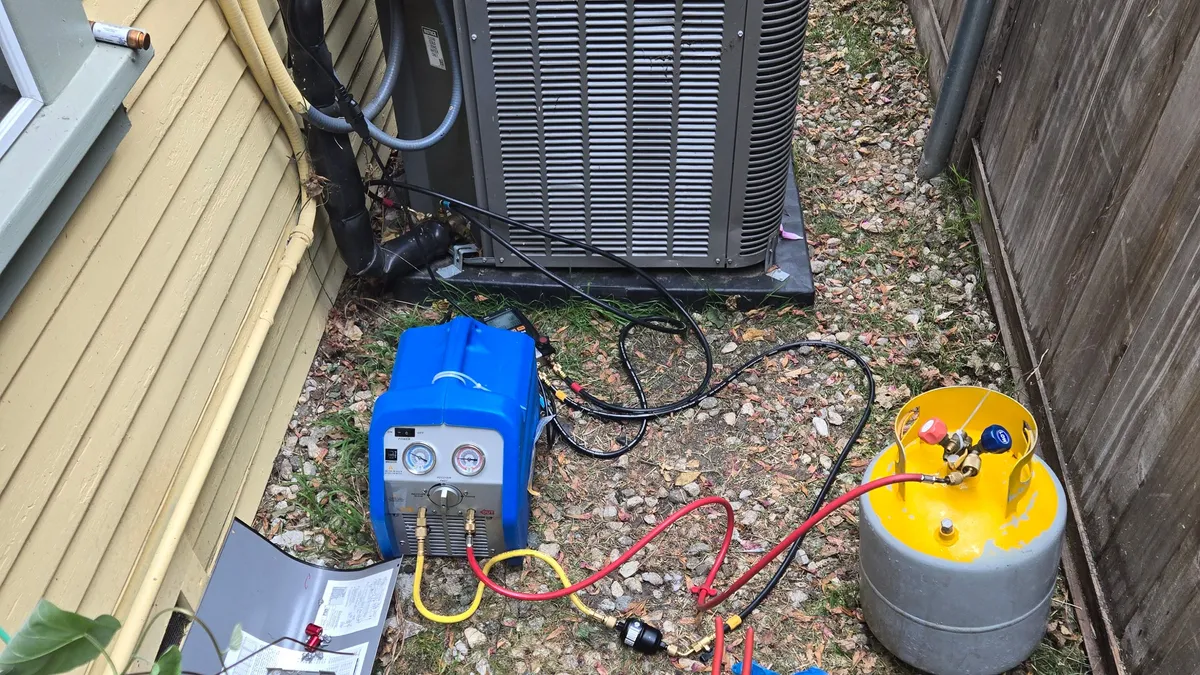
In this Lennox system, the compressor in the outdoor unit had burned out and needed replacing. The photo at the top was taken during that replacement, in May 2025.
What the photo shows
The outdoor unit sits in a side yard. Its corner panel is off and lying on the gravel, with the unit’s wiring diagram on the inside face. A blue refrigerant recovery machine and a gray recovery cylinder with a yellow top are hooked up with hoses.
Before a compressor comes out, the refrigerant in the system has to be recovered into a cylinder, and that’s the setup you’re looking at. The small black canister on the hose ahead of the recovery machine is an in-line filter. After a burnout, the refrigerant and oil can carry acid and debris, and the filter keeps them out of the machine.
Why a burned-out compressor hides its cause
A compressor that’s burned out can’t run, so there’s nothing to read on the gauges. The pressures that would point at the real problem only appear once a working compressor is pumping again.
That’s how it went on this job. We replaced the compressor, ran the system, and then saw the restriction.
What the pressures showed with the new compressor
With the new compressor running, the pressure on the suction line was far too low while the compressor kept pumping. That’s a big pressure difference across the compressor, and it’s the signature of a restriction: refrigerant isn’t getting through somewhere, so the low side of the system is starved.
Here, the restriction was the TXV. It was stuck closed.
What does a TXV do, and what happens when it sticks closed?
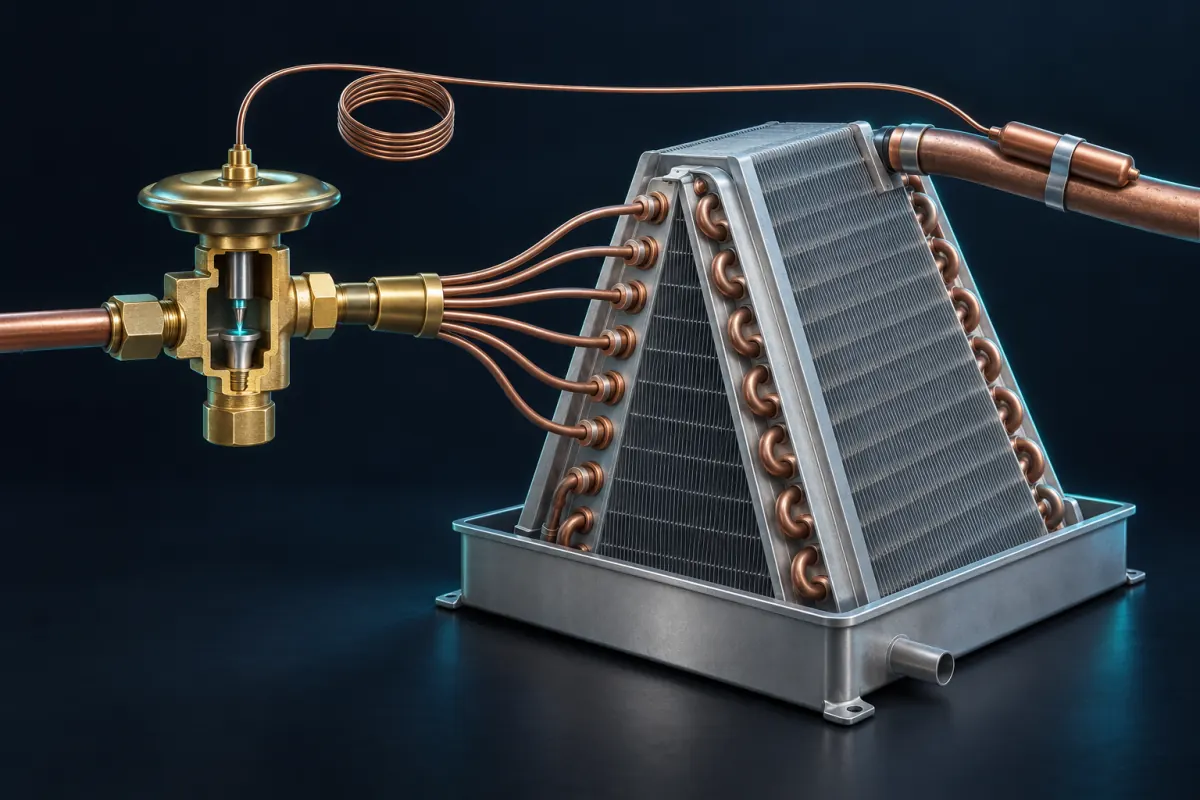
The TXV, or thermostatic expansion valve, is a small valve at the indoor coil. It meters liquid refrigerant into the coil and keeps adjusting the flow so the coil stays properly fed. When it sticks closed, very little refrigerant gets through. The indoor coil starves, the suction pressure drops very low, and only a trickle of vapor makes it back to the compressor.
That returning vapor is also what cools the motor inside most home AC compressors. Without enough of it, the compressor keeps pumping against a big pressure difference and runs hot. Run that way long enough, and the motor windings fail.
That’s what happened to the original compressor in this Lennox: it worked under those conditions for a long time and burned out.
The second repair: a new TXV
So the compressor wasn’t the end of the job. We replaced the TXV as well, and after that the system worked normally.
The lesson: find what killed the compressor
A compressor in an ordinary split system is a fairly reliable part. When one burns out, there’s usually another fault behind it, and finding that fault is part of the repair. Leave it in the system, and the new compressor works under the same conditions that killed the old one.
We’ve written up this pattern before: on a commercial rooftop condensing unit where a stuck-closed TXV burned out the compressor, and on an American Standard condenser that had lost two compressors to a seized valve. This time it was a Lennox in Brentwood.
What can you check?
If your AC stops cooling, start inside. Check that the thermostat is on COOL and set below room temperature, that the filter isn’t clogged, and that the AC breaker in your panel hasn’t tripped.
Then look at the outdoor unit from a few feet away. If it hums but the fan doesn’t spin, or the breaker trips again after a reset, switch the system off at the thermostat and leave it off. Restarting a struggling compressor again and again can make things worse.
Don’t open the outdoor unit’s panels. There’s line voltage inside, and the capacitor can hold a charge even with the power off. Refrigerant work isn’t a do-it-yourself job either: it takes Section 608 certification and recovery equipment like the machine in the photo.
When to call
Call if the system runs but doesn’t cool, or if the outdoor unit hums without starting. And if your compressor has been replaced before, ask what caused that failure.
AC compressor repair in Brentwood
We replace compressors and diagnose sealed-system problems on central air systems in Brentwood and across the Westside, Hollywood and the San Fernando Valley. The $85 service call is credited toward the repair if you go ahead, and repairs carry a 30-day labor and 90-day parts warranty. CA BEAR registered (#A 50636), EPA Section 608 Universal certified, $1M insured. See our HVAC services, read more about our work in Brentwood, or call (213) 205-2055.
FAQ
Why do AC compressors burn out?
Usually because of another fault. A compressor in an ordinary split system is a fairly reliable part, so when one burns out, something like a refrigerant restriction or an electrical problem is often behind it. On this Lennox in Brentwood, it was a TXV stuck closed.
What happens when a TXV sticks closed?
Very little refrigerant gets into the indoor coil, so the suction pressure drops very low while the compressor keeps pumping. The compressor works against a big pressure difference with too little returning vapor to cool its motor, and over time it can burn out. That's what happened to the original compressor in this Lennox.
What does very low suction pressure with the compressor running mean?
It can mean low refrigerant or a restriction. With a restriction, refrigerant isn't getting through somewhere, so the low side starves while the compressor keeps pumping. On this Lennox in Brentwood, the restriction was the TXV, stuck closed.
Why wasn't the stuck TXV found before the compressor was replaced?
A burned-out compressor can't run, so there are no pressures to read. The restriction only showed up once the new compressor was running, and then we replaced the TXV too.
Do you replace AC compressors in Brentwood?
Yes. We replace compressors, and handle the sealed-system diagnosis that goes with them, in Brentwood and across the Westside. The $85 service call is credited toward the repair if you go ahead, and you get the price after the on-site diagnosis. Call (213) 205-2055.
AC, heater or mini-split acting up? We cover LA and the Valley.
Call (213) 205-2055 or text a photo of the unit and its model sticker.