
A KitchenAid Dispenser That Wouldn't Stop — and Why the Last Repair Didn't Hold
Corrosion in the wettest spot on the door, an aftermarket fix that failed in two years, and what finally ended the midnight mopping.
In this guide
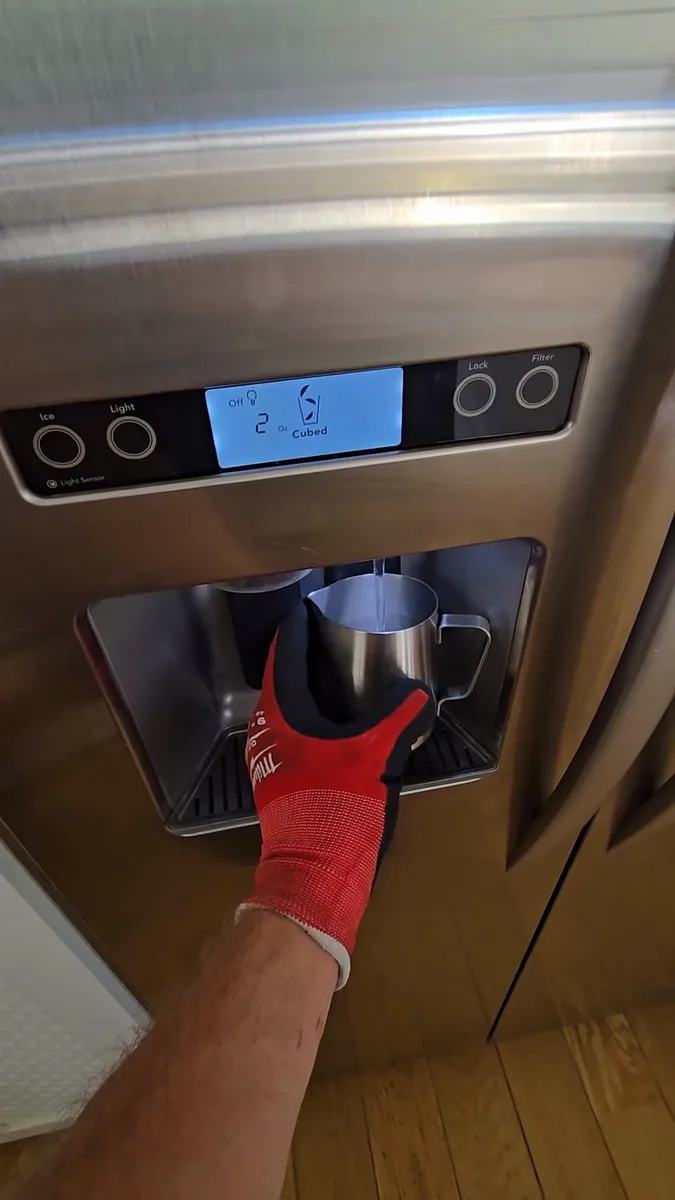
The call came in with the kind of detail you don’t forget. The water dispenser on a built-in KitchenAid had switched itself on and would not stop. Not a drip — a steady stream, running past the tray and onto the kitchen floor. The owner called it a nightmare: constant, day and night.
Why a dispenser starts running on its own
A water dispenser is a simple circuit. You press a button or a paddle, a switch closes, a valve opens, water flows. The trouble is that the refrigerator has no way to tell the difference between “someone is pressing the button” and “corrosion has bridged the contacts behind the button.” Electrically, those are the same event. Once enough corrosion builds up inside the control panel, the fridge believes a button is being held down — and it obediently dispenses water until someone shuts off the supply.
So the symptom sounds dramatic, but the diagnosis is usually short. When a dispenser runs by itself, the first suspect is the dispenser control panel, and on this KitchenAid it took one look to confirm it.
The wettest spot on the whole refrigerator
We pulled the panel off the door and found corrosion everywhere — connectors, contacts, the button membrane behind the facade.
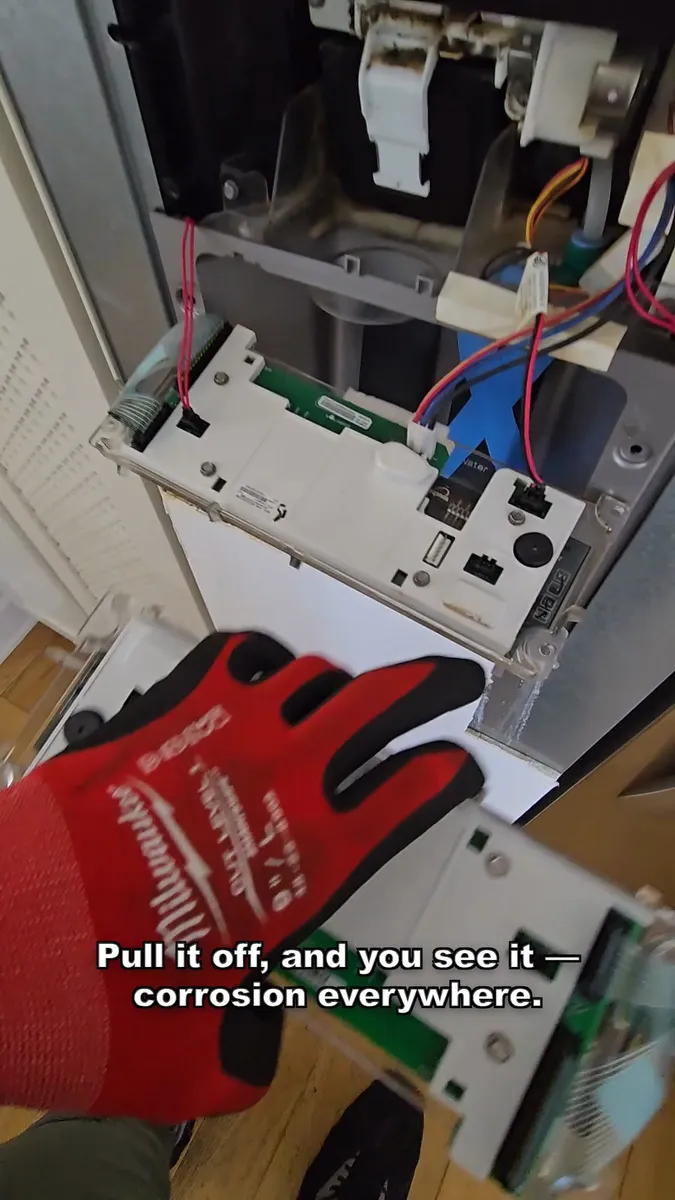
This isn’t bad luck. The dispenser area is the wettest spot on the entire refrigerator: condensation forms around the cold water line, ice cubes half-melt in the chute, splashes land on the panel every time a glass is filled. All of that moisture works its way behind the buttons, and the electronics that live there slowly rot. Of everything that can fail on a dispenser-equipped fridge, this panel fails first. We see it across brands, and on KitchenAid side-by-sides it’s the classic failure point.
The repair that didn’t hold
Here’s the part of this job worth writing about. The dispenser buttons on this refrigerator had already been replaced — about two years ago, with non-original parts. The owner only learned that distinction when the same failure came back.
Aftermarket panels and membranes exist because they’re cheap, and in a dry spot a cheap part can sometimes get away with it. The dispenser zone is not a dry spot. A part that’s sealed even slightly worse than the original doesn’t stand much of a chance there — the environment does the rest. On this refrigerator, the non-original buttons lasted about two years.
The fix: genuine OEM, plus the detail that makes it last
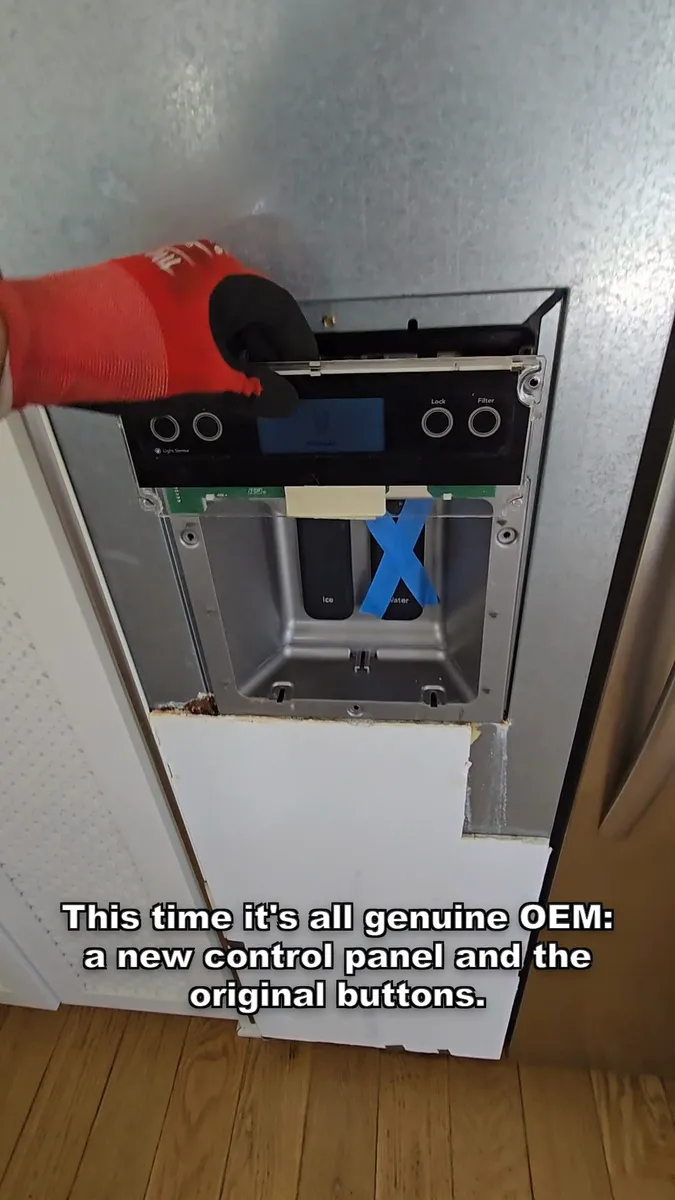
This time the refrigerator got a genuine OEM control panel and the original button membrane — the certified replacement, not a lookalike.
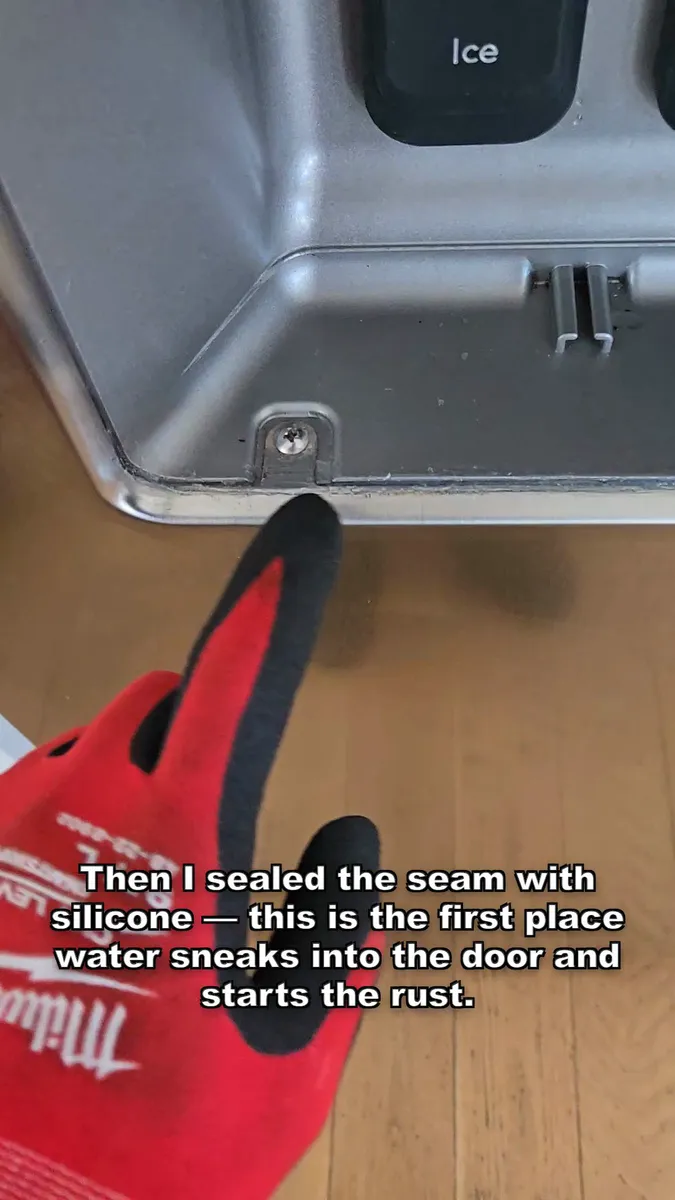
Then, before closing anything up, we ran a bead of silicone along the door seam above the dispenser. That seam is the first place water sneaks into the door; it’s where the rust on the old panel started. Sealing it takes a few minutes and protects the new parts from the exact conditions that killed the old ones. Skip it, and sooner or later the new panel inherits the old panel’s problem.
Back to being the most boring appliance in the house
Reassembled, the dispenser went back to doing its job: ice or water, cubed or crushed, only when someone actually asks for it. The display lights up, the modes switch, the floor stays dry. We back the work with our standard 30-day labor and 90-day parts warranty, and with OEM parts behind a sealed seam, this should be the last dispenser repair this refrigerator needs for years. Our refrigerator repair work on KitchenAid and other brands is built around fixing the cause, not just the part.
If your dispenser won’t stop right now
Two things to do before anyone arrives. First, try the dispenser lock — on most KitchenAid panels you hold the lock button for about three seconds, and if the panel still responds, that alone stops the water. If the panel is too far gone to obey, close the small shut-off valve on the water line behind the refrigerator (or under the nearby sink, wherever the line taps in). The mess stops immediately, and the fridge keeps cooling — it just can’t dispense until it’s repaired.
Then have the panel looked at properly. A dispenser that runs on its own, buttons that need several presses, an ice chute that misbehaves in humid weather — these are all stages of the same corrosion problem, and catching it early is a much smaller repair than water damage across a kitchen floor.
Dispenser trouble in Los Angeles? Ask about available appointments; timing depends on scheduling and parts. Our work carries 30-day labor and 90-day parts warranties. Call or text (213) 205-2055, or book online.
FAQ
Why does my KitchenAid water dispenser run by itself?
Almost always it's corrosion inside the dispenser control panel. The dispenser area stays wet from condensation and splashes, and once corrosion bridges the switch contacts, the refrigerator reads it as a button being held down — so the valve stays open and water keeps flowing.
How do I stop the water right now?
Try the dispenser lock first — on most KitchenAid panels you hold the lock button for about three seconds. If the panel no longer responds, close the shut-off valve on the water line behind the refrigerator or under the nearby sink. The fridge will keep cooling normally; it just won't dispense until it's repaired.
Why did the dispenser fail again two years after it was repaired?
The previous repair used non-original buttons. The dispenser zone is constantly wet, and aftermarket parts that aren't sealed as well as the originals fail quickly there — on this refrigerator they lasted about two years. That's why the second repair used a genuine OEM panel and membrane.
Are OEM parts really worth the extra cost?
In dry locations the difference can be small. In the dispenser zone it's decisive: original panels are built and sealed for constant moisture, so an OEM repair is usually the last one, while an aftermarket repair is often just the first of several.
What is the silicone seal for?
The door seam above the dispenser is the first place water sneaks inside the door — it's where the corrosion that kills the panel begins. Sealing that seam with silicone takes minutes and protects the new panel from the exact conditions that destroyed the old one.
Does a failed control panel mean the whole door has to be replaced?
No. The control panel and button membrane are serviceable parts — they come off the door and are replaced on their own. Door replacement is a last resort for physical damage, not for panel corrosion.
Got an appliance that needs fixing? We cover LA and the Valley.
Call (213) 205-2055 or text a photo of your appliance.