
An empty geothermal heat pump in Hollywood: we found the leak with nitrogen and brazed it on the spot
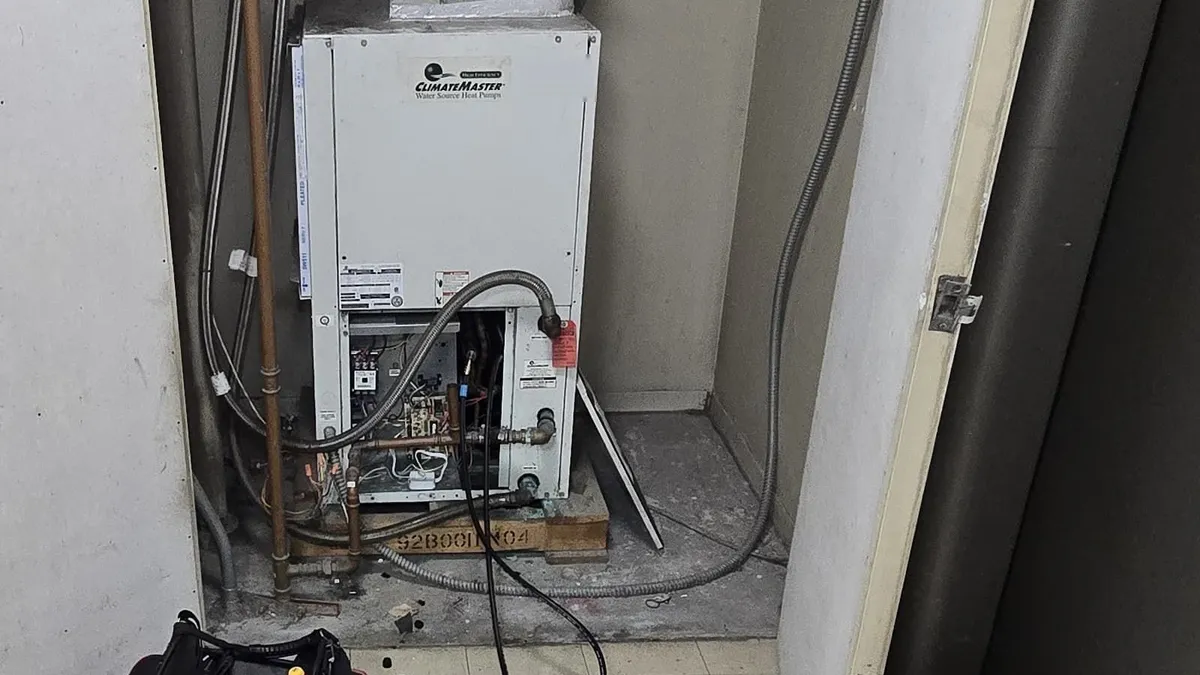
A ClimateMaster water-to-air unit in a building's utility closet. It worked right after the recharge, and the fire alarm went off while we were brazing.
In this guide
A geothermal heat pump in a Hollywood building was empty, with no refrigerant left in it. We pressurized the system with nitrogen and found the leak inside the unit. Then we brazed it on the spot and charged the system, and it started working right away. Partway through the brazing, the fire alarm went off.
What kind of heat pump is this?
We call units like this geothermal heat pumps. The label on this one reads ClimateMaster, Water Source Heat Pumps, which is the industry’s name for this family of equipment: water-to-air heat pumps.
A regular heat pump trades heat with the outdoor air through a unit outside. This kind trades heat with water instead. In cooling mode, it pulls heat out of the room air and sends it into the water, and in heating mode it runs the other way. Where that water goes depends on the system: in a geothermal system, the loop runs through the ground, while in many multi-story buildings a shared water loop serves the units.
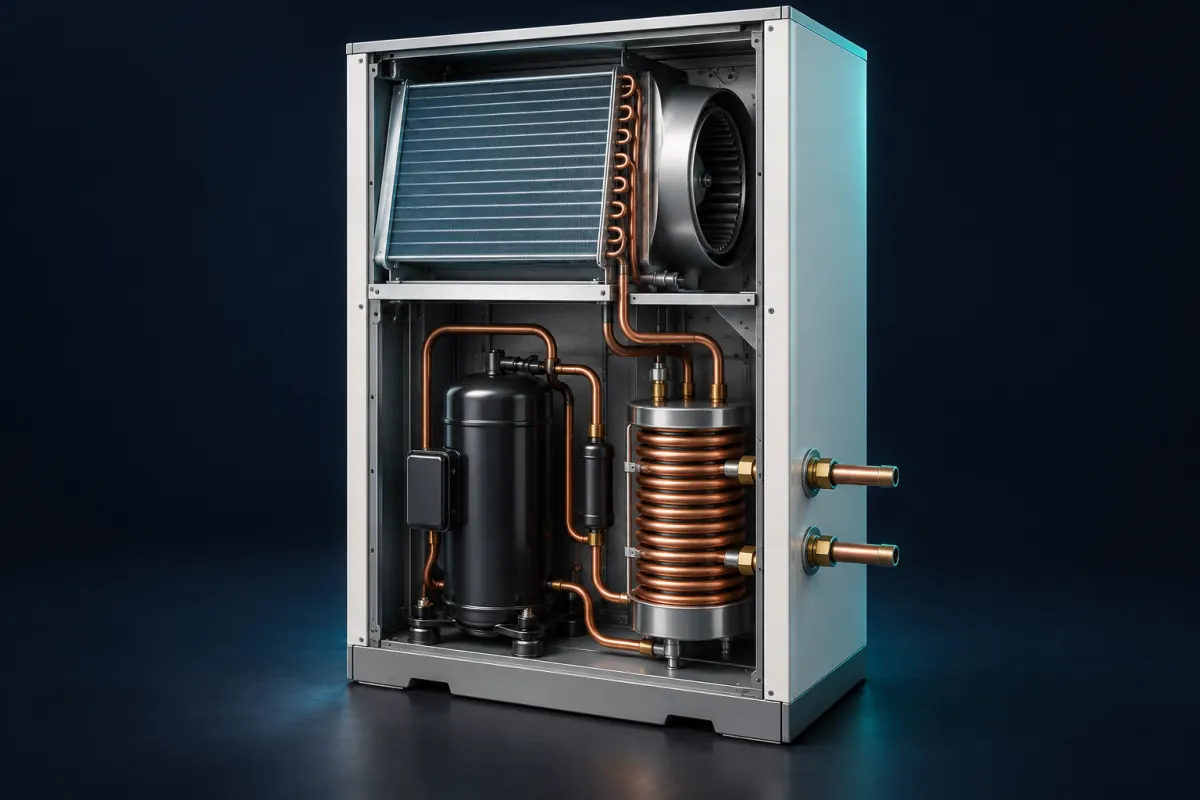
Inside, the refrigerant side works like any heat pump’s. There’s a compressor, a coil that moves heat into or out of the room air, a heat exchanger on the water side, and a sealed refrigerant circuit that connects them. On a unit like this, that whole circuit sits inside one cabinet, with no line set running to an outdoor unit.
The photo at the top of this page is from the job: the unit’s lower service panel is off, and a refrigerant gauge hose is connected to it.
The system was empty
There was no refrigerant left in the system. Without refrigerant, a heat pump can’t move heat in either direction, so it can’t heat and it can’t cool.
Refrigerant doesn’t get used up. When a sealed system is empty, the refrigerant got out somewhere, and the work starts with finding where.
What else can stop a water-to-air heat pump?
On a water-to-air unit, the water side matters as much as the refrigerant side. If water isn’t flowing through the unit’s heat exchanger, the unit has nowhere to send heat and nowhere to pick it up, and its safety controls can shut the compressor off. Units like this also carry pressure switches that stop the compressor when refrigerant pressure goes out of range. An empty system is one way to trip them.
That’s why a no-heat, no-cool call on one of these needs a look at both sides before anyone reaches for a torch. On this unit, the problem was on the refrigerant side: the system was empty.
How do you find a leak in a system with nothing in it?
With nitrogen. An empty system has no pressure inside, so nothing pushes out through the leak and there’s nothing to trace. Filling the circuit with dry nitrogen changes that. Nitrogen is inert and carries no moisture, which makes it the standard gas for pressurizing a system to hunt for a leak. Once the circuit is under pressure, the gas escapes at the opening, and that’s the spot a technician looks for.
That’s how we found this one. The leak was inside the unit.
Brazing it on the spot
We brazed the leak right there. Brazing joins copper with a filler metal that a torch melts into the joint. It takes a lot of heat, and it gives off fumes.
Working with a torch indoors takes preparation. We wrote up a mini-split line we brazed inside a ceiling, where most of the work was protecting the wood and insulation around the joint.
Then the fire alarm went off
While we were brazing, the fire alarm went off. Building staff came running, and they saw that everything was under control. It was just an interesting moment on the job.
If you manage a building with units like this one, plan for it. Brazing indoors makes heat and fumes, and either can set off a nearby detector. It’s worth coordinating with the technician before a torch comes out, so your staff knows what’s going on.
Charged, and running right away
After the repair, we charged the system with refrigerant, and it started working right away.
A heat pump moves heat only as well as its charge allows, which is why the leak gets fixed before the refrigerant goes back in. Adding refrigerant to a system that’s still leaking only buys time.
What you can check yourself
If a heat pump like this runs but doesn’t heat or cool, start with the thermostat. Make sure it’s in the right mode, and that the setting should make it run: below the room temperature for cooling, above it for heating.
Next, the air filter. Units like this have one, and a clogged filter cuts the airflow. If you can reach it without opening a service panel, check it and replace it if it’s dirty.
If nothing runs at all, check the breaker. Don’t open the cabinet’s service panels, though. There’s line voltage inside, and the refrigerant circuit is under pressure.
When to call
Call if the unit runs but the air coming out isn’t warm or cool, or if it has been recharged before and stopped working again. A system that keeps needing refrigerant has a leak somewhere, and that leak is the real repair.
Heat pump service in Hollywood
We service heat pumps and central AC across the Westside, Hollywood and the San Fernando Valley, including water-to-air units like this one. The $85 service call is credited toward the repair if you go ahead, and the price comes after we diagnose the system on site. Repairs carry a 30-day labor and 90-day parts warranty. CA BEAR registered (#A 50636), EPA Section 608 Universal certified and $1M insured. See our HVAC services, read more about our work in Hollywood, or call (213) 205-2055.
FAQ
Is a water-source heat pump the same as a geothermal heat pump?
They're the same family: water-to-air heat pumps that trade heat with a water loop instead of the outdoor air. In a geothermal system, that loop runs through the ground. In many buildings, a shared water loop serves the units. The label on this Hollywood unit reads ClimateMaster, Water Source Heat Pumps.
How do you find a refrigerant leak in an empty heat pump?
By filling the system with dry nitrogen. An empty system has no pressure inside, so nothing comes out of the leak until the circuit is pressurized. With nitrogen in it, the gas escapes at the leak, and that's the spot to find. On this unit, the leak was inside the cabinet.
Can a heat pump refrigerant leak be repaired where the unit stands?
Often, depending on where the leak is and how much room there is to work. On this Hollywood unit, we brazed the leak right there and charged the system with refrigerant, and it started working right away.
Can brazing set off a fire alarm?
It can. A brazing torch makes heat and fumes, and either can set off a nearby detector. On this job, the alarm went off while we were brazing, and building staff came running and saw that everything was under control. In a building, it's worth coordinating with the technician before any brazing indoors.
Do you service heat pumps in Hollywood?
Yes, including water-to-air units like this one. The $85 service call is credited toward the repair if you go ahead, and the price comes after the on-site diagnosis.
AC, heater or mini-split acting up? We cover LA and the Valley.
Call (213) 205-2055 or text a photo of the unit and its model sticker.