
An AC that wasn't cooling in Winnetka: frost after the filter drier gave the restriction away
May 2025. The copper frosted after the filter drier and not before it. We pumped the system down, replaced the drier, checked the TXV screen and started it again.
In this guide
A customer in Winnetka called because their AC wasn’t cooling. The photos from this job show the fault about as clearly as a photo can: the copper line frosted right after the filter drier and stayed clear before it. That’s a restricted drier. We pumped the system down, replaced the drier, checked the TXV screen, evacuated the system and started it, and the AC worked.
The complaint: no cooling
In May 2025, a customer in Winnetka told us their air conditioner wasn’t cooling. We started the system with our gauges connected to see what it was doing.
What did the gauges show?
There was a big difference in pressure between the suction line and the liquid line.
The suction line is the larger, insulated copper line. It carries refrigerant vapor back to the compressor at low pressure. The liquid line is the smaller one, and it carries liquid refrigerant at high pressure from the outdoor unit to the indoor coil. Some difference between the two is normal, since one side of the system runs at low pressure and the other at high. A restriction in the liquid line stretches that gap. Refrigerant can’t get through to the indoor coil, so the suction side runs low while the high side stays up.
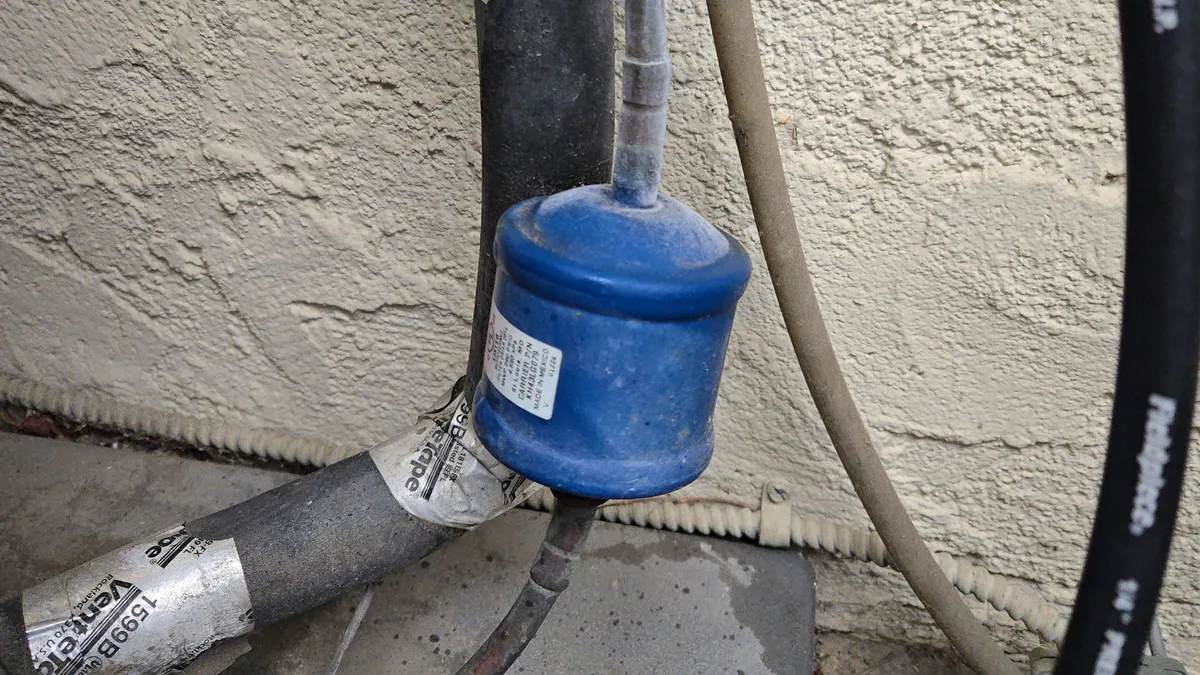
Frost after the filter drier, and none before it
In the photo at the top of this page, you can see the second clue. The blue canister on the smaller copper line is the filter drier. Coming out of it, the copper running up the wall toward the house is white with frost, while the line feeding into it from the outdoor unit isn’t.
A restricted drier acts like a valve that’s partly closed. Refrigerant squeezing through it loses pressure, and when refrigerant loses pressure, its temperature drops. An AC does that on purpose at its metering device by the indoor coil, which is how it makes cold where you want it. A clogged drier does it outside, in the wrong place, and the copper right after it gets cold enough to frost. The line before the drier stays at normal liquid-line temperature. That’s why the frost starts at the drier and not earlier.
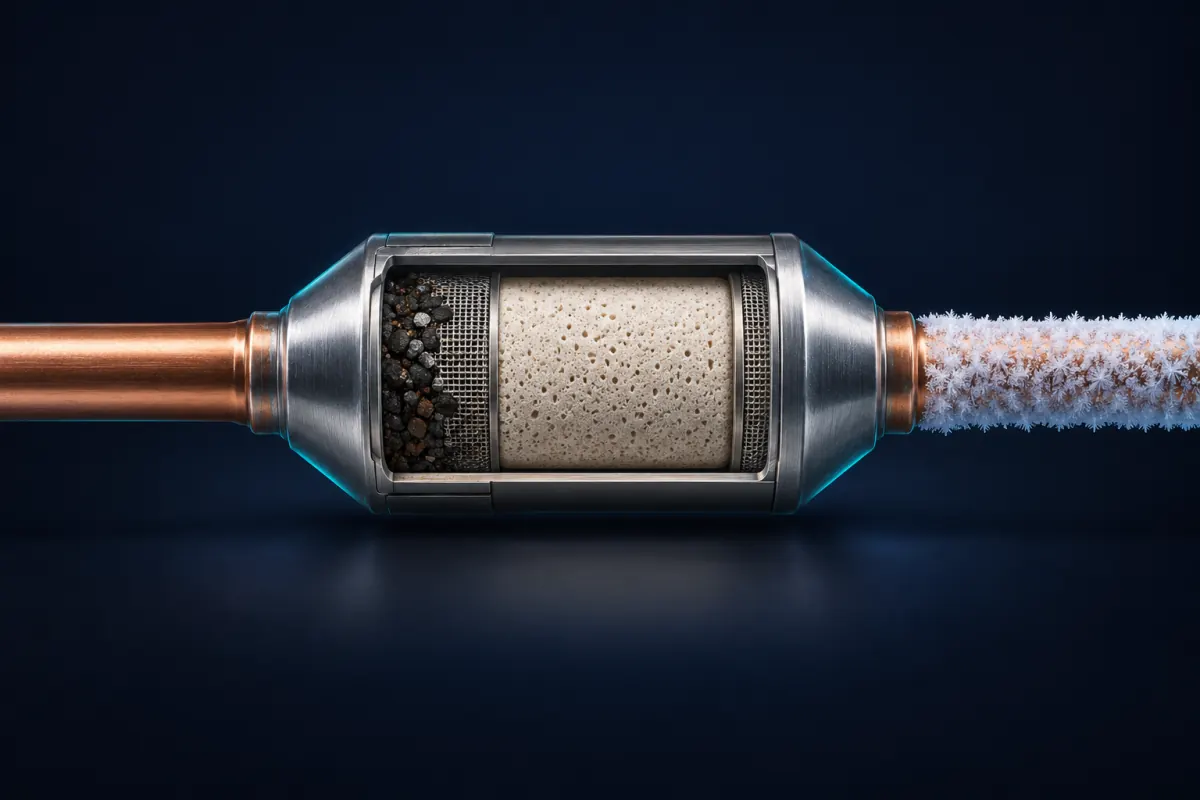
Frost that starts at a drier is a classic restriction sign, and on this system it was plain to see.
What a filter drier does
A filter drier is a small canister brazed into the liquid line. Inside, a desiccant core soaks up moisture, and a filter catches particles, so neither one keeps circulating through the compressor and the metering device. Over time, or after something contaminates the system, a drier can load up enough to restrict the flow. Then it has to be replaced.
Why a restriction means no cooling
Past the restriction, the indoor coil doesn’t get enough refrigerant. A starved coil can’t absorb much heat from the air blowing across it, so the air coming out of the vents isn’t cold. The compressor keeps running, but the system isn’t moving much heat.
How we replaced the drier
Pumped the refrigerant down into the condenser
First, we pumped the refrigerant down into the condenser unit and closed the valves. In a pump-down, the technician closes the liquid-line service valve and lets the compressor pull the refrigerant out of the indoor coil and the lines and push it into the outdoor unit. Then the suction valve gets closed too. The charge stays sealed in the condenser while the lines are open, so none of it escapes.
Blew out the system and the lines
Before the new drier went in, we blew out the system and the lines. Purging pushes dry nitrogen through the copper and carries out loose debris and moisture, so they don’t end up in the new drier.
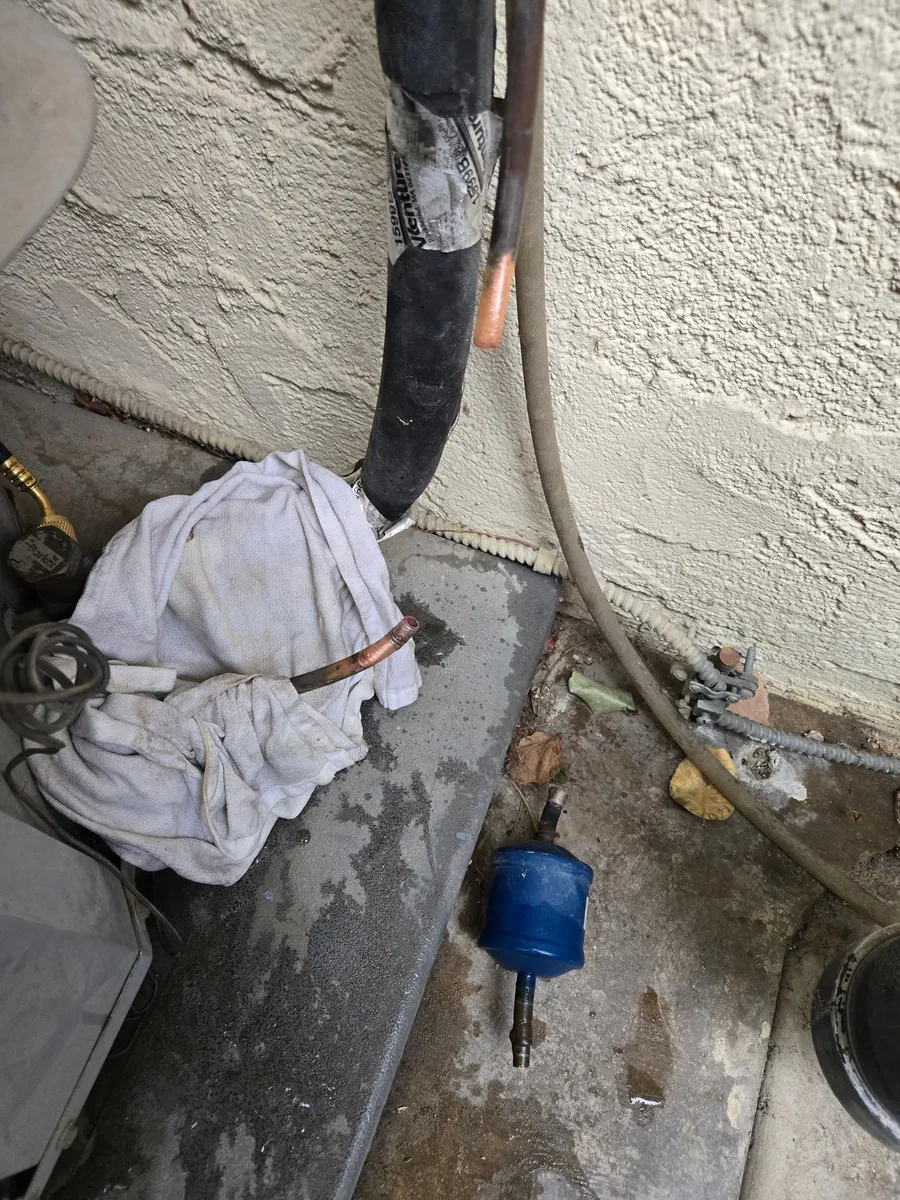
The second photo shows the line opened up: the old drier lies on the pad, and the two open ends of the copper are waiting for the new one.
Brazed in a new filter drier
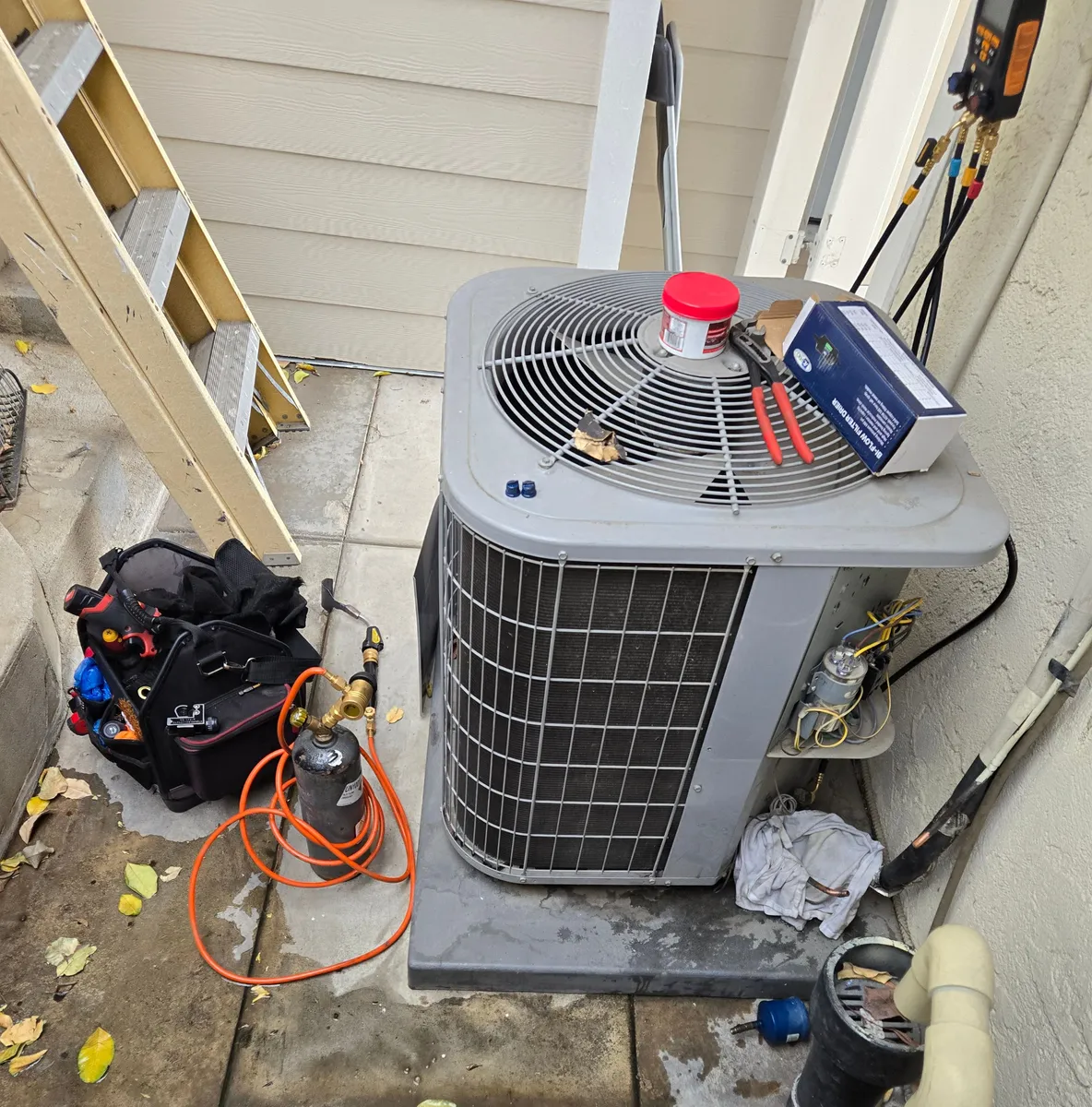
Then we brazed in a new filter drier. In the third photo, it’s still in its box on top of the condenser, with the gauge manifold hooked up on the right and the torch kit beside the tool bag on the left.
Checked the TXV screen
We also checked the screen at the TXV. The TXV, or thermostatic expansion valve, is the metering device at the indoor coil, and many have a small mesh screen at the inlet. A clogged screen there would starve the coil the same way the drier did, so it’s worth a look while the system is open.
A TXV can make a restriction of its own, too. On a commercial condensing unit on a Los Angeles rooftop, a stuck TXV choked the refrigerant flow.
Evacuated, checked and started
Then we evacuated the system, checked it and started it, and the AC worked. Evacuation pulls air and moisture out of the part of the system that was opened. After a pump-down, that’s the lines and the indoor coil, while the charge waits in the condenser until they’re clear.
Is a filter drier the same as the air filter?
No, and it’s an easy mix-up. You’ll find the air filter in the return grille or in the indoor unit, and you can change it yourself. The filter drier is on the refrigerant line, sealed and brazed in, and replacing it is refrigerant work for a technician.
What you can check at home
Start with the basics. Make sure the thermostat is set to cool and below the room temperature. Check the air filter and replace it if it’s dirty, since a clogged air filter can also make an AC cool poorly. Look at the AC breaker in your electrical panel. Then clear leaves and debris away from the outdoor unit.
After that, look at the copper lines at the outdoor unit without touching them. Frost or ice on them in warm weather is a warning. Turn the system off at the thermostat, don’t chip at the ice, and call. Don’t open any panels: there’s line voltage inside.
When to call
Call if the AC runs but the air from the vents isn’t cold, or if you see frost or ice on the copper lines or the outdoor unit. A system that runs for hours without bringing the temperature down needs a look, too.
AC repair in Winnetka
We repair central AC systems in Winnetka and across the San Fernando Valley. The $85 service call is credited toward the repair if you go ahead, and the price comes after we diagnose the system on site. Repairs carry a 30-day labor and 90-day parts warranty. CA BEAR registered (#A 50636), EPA Section 608 Universal certified and $1M insured. See our HVAC services, read more about our work in Winnetka, or call (213) 205-2055.
FAQ
What does a filter drier do in an air conditioner?
It catches moisture and debris in the liquid line. Inside the canister, a desiccant core soaks up moisture and a filter traps particles, so neither keeps circulating through the system. Over time, or after the system gets contaminated, a drier can load up and restrict the flow of refrigerant.
Why would an AC line frost right after the filter drier?
Because the drier is restricted. Refrigerant squeezing through a clogged drier loses pressure, and its temperature drops with it, so the copper right after the drier gets cold enough to frost while the line before it doesn't. On this Winnetka AC, the line frosted after the drier and not before it.
Is the filter drier the same as my AC's air filter?
No. The air filter cleans the air moving through your system, and you can change it yourself. The filter drier sits on the refrigerant line, brazed in, and replacing it is refrigerant work for a technician.
How do you replace a filter drier without losing refrigerant?
With a pump-down. The compressor pulls the refrigerant into the outdoor unit and the technician closes the service valves, so the charge stays sealed in the condenser while the line is open. On this job, we pumped the system down, blew out the system and the lines, brazed in a new drier and checked the TXV screen, then evacuated the system and started it.
Do you repair AC systems in Winnetka?
Yes. We repair central AC systems in Winnetka and across the San Fernando Valley. The $85 service call is credited toward the repair if you go ahead, and the price comes after the on-site diagnosis.
AC, heater or mini-split acting up? We cover LA and the Valley.
Call (213) 205-2055 or text a photo of the unit and its model sticker.