
This Dryer Went 15 Years Without Maintenance — and It Had Already Started to Burn
Inside a Los Angeles dryer packed wall-to-wall with lint, why that lint ignites like gunpowder, and what a real annual cleaning looks like.
In this guide
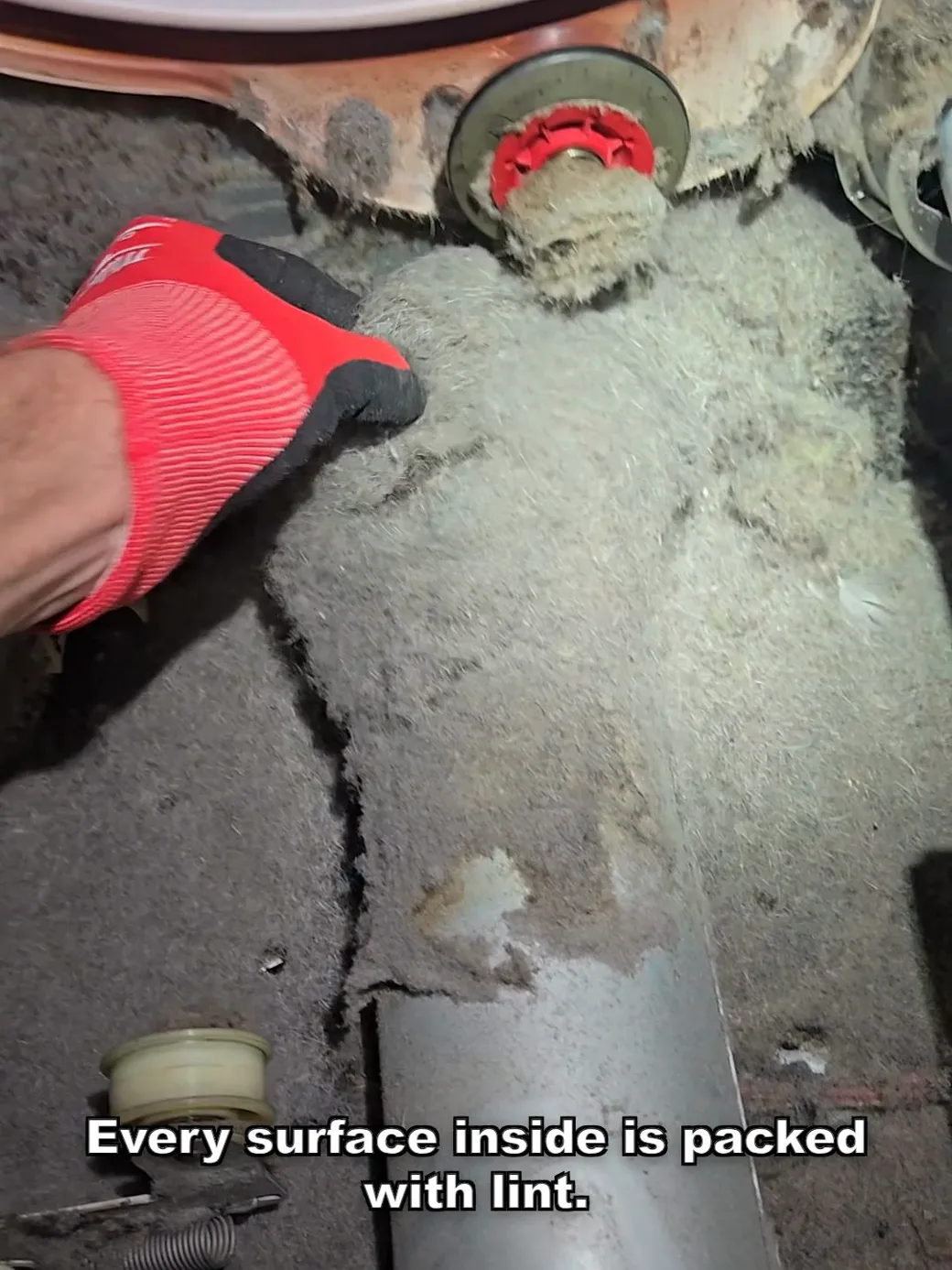
Some service calls are routine. This one stopped us for a second. The dryer — a perfectly ordinary machine in a Los Angeles home — hadn’t been opened or serviced in fifteen years. When we pulled the cabinet apart, every surface inside was buried under a continuous blanket of lint: the base, the ducts, the motor, the frame. And in one spot, right where the heat lives, that blanket had turned black. Not dusty-black. Scorched. This dryer had already started to catch fire — it just hadn’t managed to finish yet. (The short clip from this exact job is at the top of the page.)
Here’s what we found inside, why lint is so much more dangerous than people think, and what a proper annual dryer service actually involves.
Fifteen years of lint, in one machine
The lint screen you clean between loads catches only part of what your laundry sheds. The rest rides the airflow into the machine itself — into the internal ducts, around the blower wheel, across the motor, and down into the base of the cabinet. Load after load, year after year, it settles and compacts into a dense felt.
Fifteen years of that looks like the photo above: a solid, packed layer you can press your hand into. At that point the dryer isn’t just dirty. It’s insulated in fuel.
Lint ignites like gunpowder
Lint is finely divided cotton and synthetic fiber with an enormous surface area — which is exactly what you’d design if you wanted a material to ignite instantly. A spark or enough heat, and it doesn’t smolder politely. It flashes.
That’s not a scare line; it’s the statistics. U.S. fire agencies count around 3,000 dryer fires a year, and the leading cause isn’t faulty wiring or bad parts — it’s failure to clean. And it doesn’t matter what fuel your dryer burns: a gas dryer has an open burner flame, an electric one has a glowing heating element, and every dryer ever made builds up the same lint. In Los Angeles, where nearly everything is wood-frame construction, a dryer fire that gets out of the cabinet has a house full of fuel waiting for it.
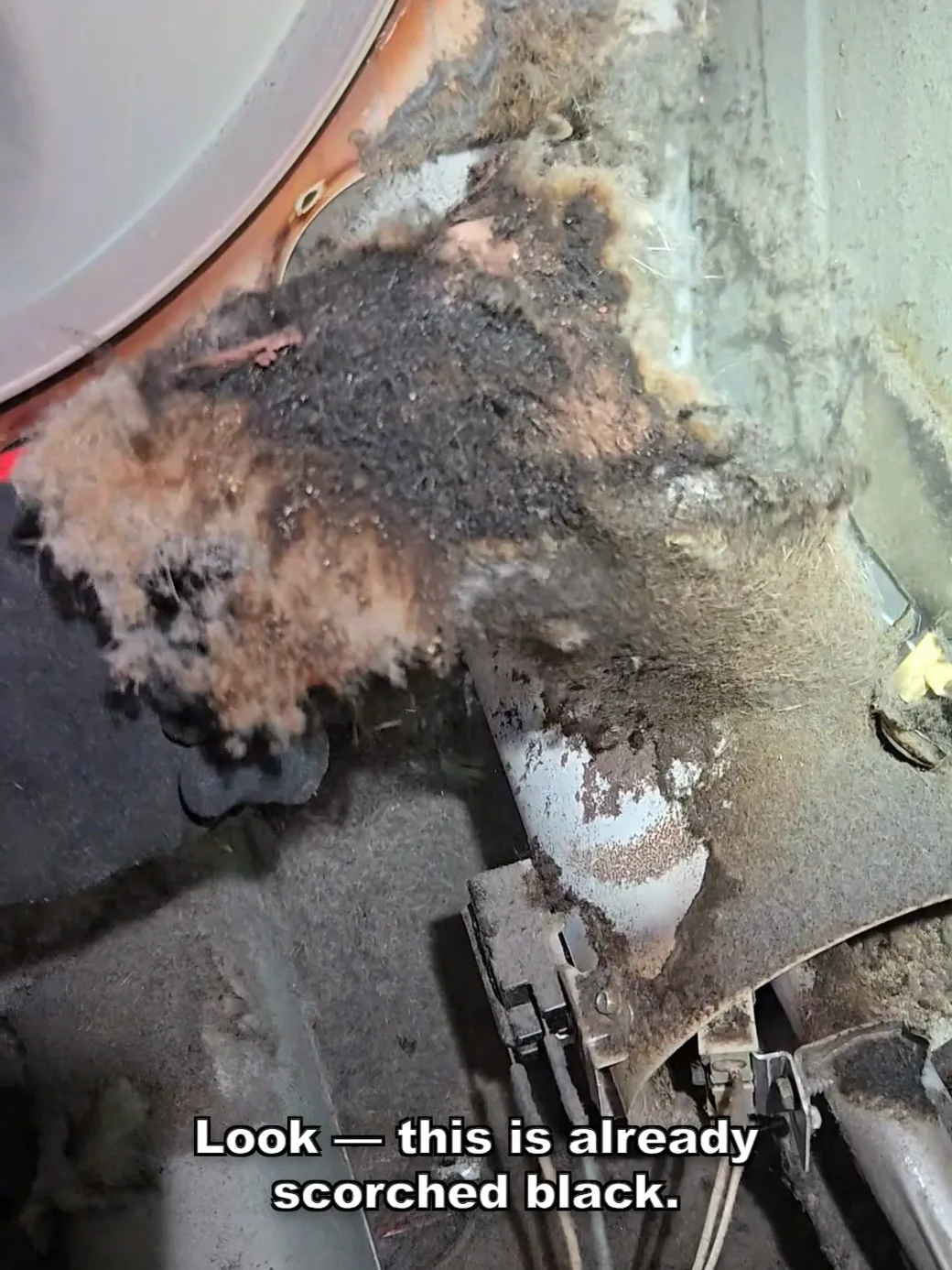
On this machine, we found the proof mid-teardown. The lint packed along the heat path was charred black and fused. At some point — maybe one long drying cycle, maybe a dozen — it had gotten hot enough to ignite and then, by pure luck, starved out instead of spreading. The homeowners never knew. Most people whose dryers burn never got that second chance.
The squeak is the same disease
There’s a second failure hiding in all that lint, and if you own a dryer you’ve probably heard it: the squeak.
In most dryers the drum rides on small support rollers. They sit low in the cabinet — exactly where lint settles — so they pack up with lint and pet hair, the hair winds around the shafts, and the bearings run dry. First the dryer starts squealing on every rotation. Left alone, the rollers flat-spot or seize, the drum drags, and eventually the belt or the motor pays for it. Worn-out drum rollers are one of the most common dryer failures we see, and the root cause is the same as the fire risk: nobody ever opens the machine.
On this unit we got there in time. The rollers were still in good shape underneath the grime — so we cleaned them, greased them, and put them back to work instead of selling parts the machine didn’t need. That’s the difference a yearly service makes: you catch the rollers while they’re still saveable.
What a real annual service involves
“Dryer maintenance” doesn’t mean wiping the lint screen. The screen you should be emptying every load anyway. The service is a teardown:
- Vacuum everything. Every internal duct, the blower wheel, the base of the cabinet, across the motor — all of the packed-in lint has to come out, not just the easy layer on top.
- Clean around the heat. The burner assembly on a gas dryer, the element housing on an electric one. This is the ignition point, so it’s the part that matters most.
- Service the drum rollers. Strip the lint and wound-up hair off, grease the shafts, and spin-test them. Good rollers go back in; worn ones get replaced before they fail loudly.
- Check the belt. Glazing, cracks, and slack all show up long before a belt snaps mid-load.
- Check the venting end to end. The exhaust run from the machine to the outside wall clogs with the same lint, chokes the airflow, and doubles as a fire path. A blocked vent also makes the dryer run long and hot — if your loads take two cycles to dry, that’s often why. The CPSC safety alert on overheated clothes dryers (PDF) flags that exact symptom: clothes still damp after a normal cycle can mean a blocked lint screen or exhaust duct.
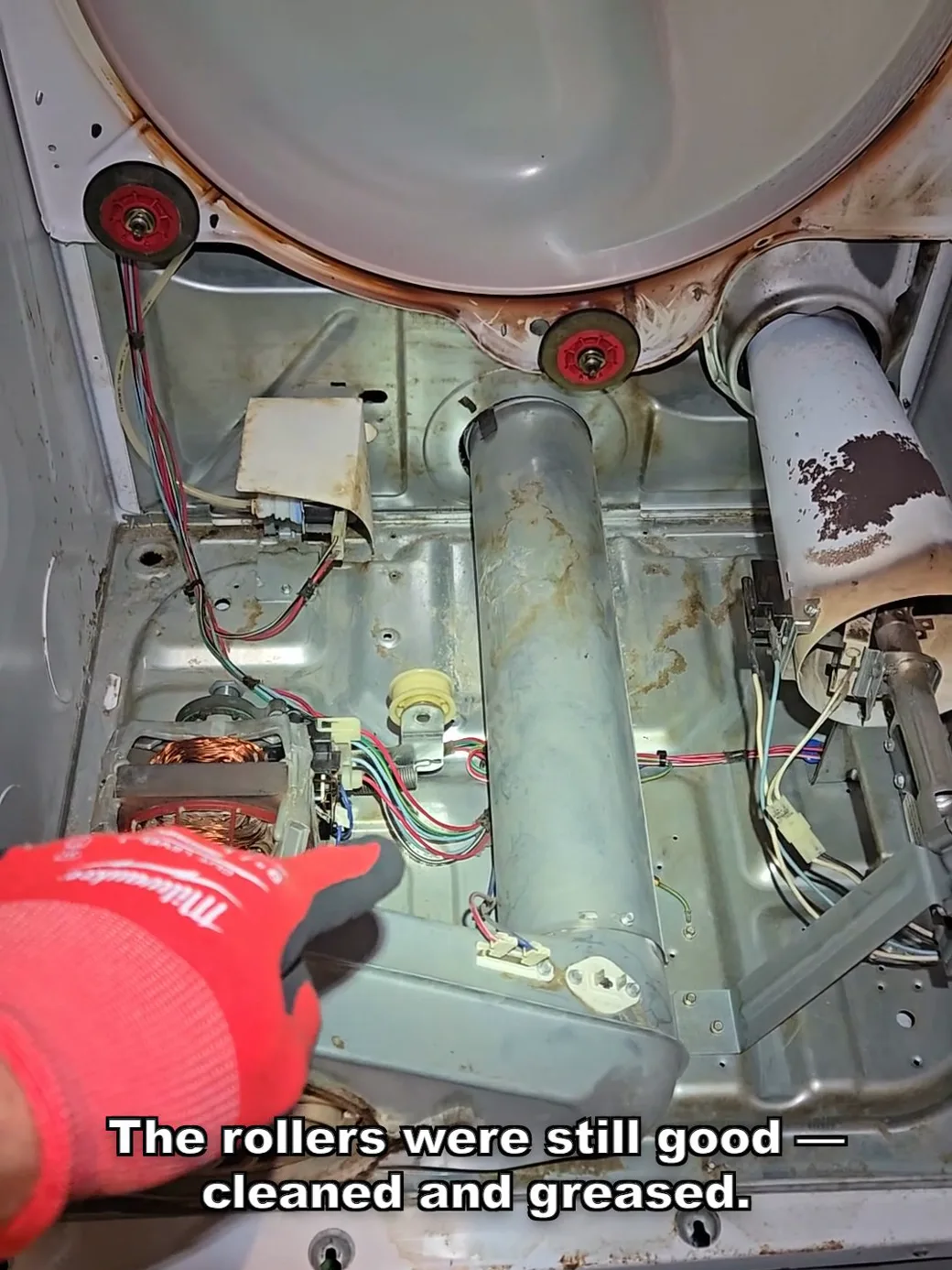
Then it all goes back together and gets a test run. On this machine the transformation was the photo above: clean base, freshly greased rollers turning silently, a clean motor, and — the part we care about most — nothing flammable anywhere near the burner. One visit, and the machine went from a stalled fire back to a boring, quiet appliance. Boring is the goal. You can book exactly this through our dryer repair service.
Once a year — before a fire does it for you
Every dryer earns this service once a year. Not because the machine is fragile, but because lint accumulation is not a maybe — it’s physics, and it’s happening in your dryer right now at whatever rate your household generates laundry. Pets, kids, towels, and long vent runs all speed up the clock.
If your dryer squeaks, smells hot, takes two cycles to dry a load, or simply hasn’t been opened since it was installed — that’s the machine asking. And if you’re weighing whether an older dryer is worth servicing at all, our repair-versus-replace framework walks through the honest math.
Epic Star Inc has completed 1,266+ appliance repairs across Westside LA since 2024. We’re California BEAR registered (#A 50636), EPA Section 608 Universal certified, carry $1M general liability insurance, and back our labor with a 30-day warranty. Same-day appointments are subject to booking availability, and your $85 service call is credited toward the repair when service proceeds. We work in English and Spanish.
Call (213) 205-2055
FAQ
How often should a dryer be cleaned out?
At least once a year — a full interior cleaning, not just the lint screen. The screen catches only part of the lint; the rest settles inside the cabinet, in the blower, in the internal ducts, and around the heat source. The dryer in this story went fifteen years without that service, and the lint inside had already started to burn. If you dry a lot of loads, have pets, or your vent run is long, once a year is the minimum.
Is dryer lint really a fire hazard?
Yes — it's one of the most flammable things in your house. Lint is finely divided cotton and synthetic fiber with a huge surface area, and it ignites almost instantly, like gunpowder. U.S. fire agencies count around 3,000 dryer fires a year, and failure to clean is the leading cause. In a wood-frame house — which is most of Los Angeles — a dryer fire has plenty to feed on once it escapes the cabinet.
Why is my dryer squeaking?
In most dryers, the drum rides on small support rollers, and those rollers are usually the squeak. They sit low in the cabinet where lint settles, so they pack up with lint and pet hair, the bearings wear dry, and hair winds around the shafts. First they squeal, then they flat-spot or seize, and the drum stops turning smoothly. Cleaned and greased in time, good rollers keep going; worn ones need replacing before they take the belt with them.
Do gas and electric dryers both build up lint?
Both, equally — lint comes from your laundry, not from the fuel. The difference is where the heat lives: a gas dryer has an open burner flame, an electric one has a glowing element. Lint packed around either one is the classic ignition point, which is why cleaning around the heat source is the most important part of the service.
Can I clean my dryer myself?
You can and should do the basics: empty the lint screen every load and disconnect and clear the exhaust hose a couple of times a year. The full service is another matter — it means unplugging the machine (and closing the gas valve on a gas unit), pulling the cabinet apart, vacuuming the blower wheel and internal ducts, cleaning around the burner or element, and greasing or replacing the drum rollers. If you're comfortable doing all of that, go for it. Most people aren't, and a botched reassembly on a gas dryer is its own hazard — that's what we're for.
How long does dryer maintenance take?
Usually about an hour to an hour and a half on site: teardown, a thorough vacuum of every duct and the blower, cleaning around the heat source, rollers cleaned and greased (or replaced), belt checked, vent checked, reassembled and test-run. We handle it in a single visit, and ask about available appointments; timing depends on scheduling and parts.
How much does dryer maintenance cost?
We quote a flat rate upfront before any work starts, and the $85 service call is credited toward the repair when service proceeds. It's a small fraction of what a dryer fire — or even a seized drum roller that shreds the belt — ends up costing. For a sense of how we price repair work in general, see our Los Angeles appliance repair cost guide.
Does Epic Star service dryers in Los Angeles?
Yes — gas and electric, all major brands, across the Westside and San Fernando Valley. Maintenance, squeaks, no-heat calls, vent problems: we'll open it up, show you what we find, and tell you honestly what it needs. Call or text (213) 205-2055.
Got an appliance that needs fixing? We cover LA and the Valley.
Call (213) 205-2055 or text a photo of your appliance.